Blogfield notes
What Are Business Skills and Why Every SaaS Team Needs Them
Business skills are the mix of collaboration, self management, and decision making abilities that let people get work done across teams. Employers in one major recruiter survey said the most required skills for business school hires were working with others 93% , managing self 89
Business skills are the mix of collaboration, self-management, and decision-making abilities that let people get work done across teams. Employers in one major recruiter survey said the most required skills for business school hires were working with others (93%), managing self (89%), problem solving (87%), adaptability or flexibility (86%), listening (86%), and organization or time management (85%).
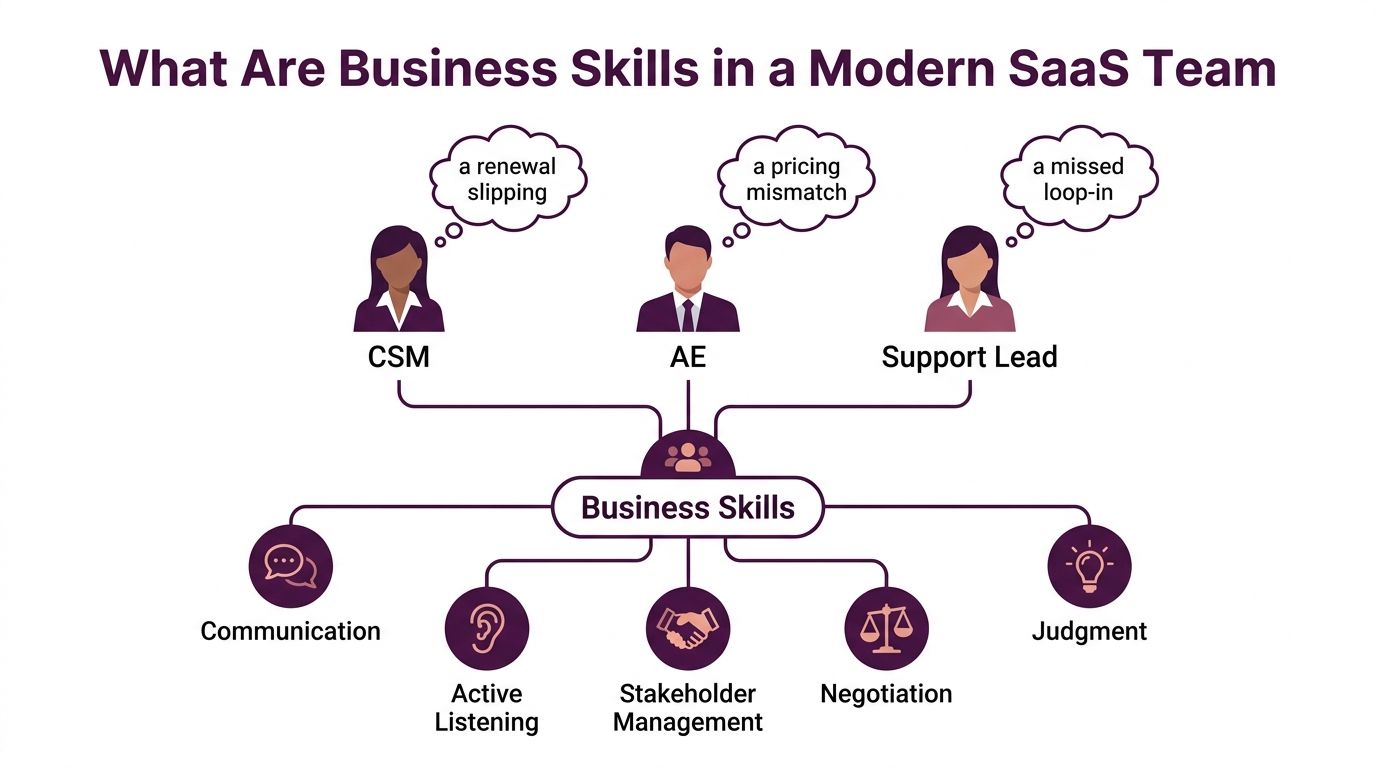
If you're leading or working inside a SaaS team, you already feel this every week. A renewal slips because the CSM didn't pull in product early. An AE offers a discount the billing setup can't support. Support learns about the customer mess during the QBR instead of before it. None of those failures come from a lack of effort. They come from weak business skills in motion.
The simplest way to define business skills is this: a layered mix of judgment, collaboration, and execution abilities that helps someone move work forward without creating chaos for the next team. In SaaS, that shows up in places you can see. Slack handoffs. CRM notes. Pricing approvals. Escalation calls. Dashboard reviews. Customer follow-ups.
Most articles answer the question "what are business skills" with a generic list. Communication. Leadership. Teamwork. That's not wrong, but it isn't useful enough. SaaS teams need a more operational definition. They need to know which skills help people coordinate, which skills help them make better calls, and which skills can now be reinforced by AI coworkers inside the tools people already use.
Table of Contents
- What Are Business Skills in a Modern SaaS Team
- Soft Skills That Hold SaaS Teams Together
- Hard and Analytical Skills That Drive Decisions
- How Business Skills Differ Across Sales, Product, and Support
- Why Skill Gaps Are Now a Growth Bottleneck
- How AI Coworkers Operationalize Business Skills
- Building a Skills-First Operating Rhythm for Your Team
What Are Business Skills in a Modern SaaS Team
A lot of founders learn this the hard way. The account is healthy on paper, then the renewal goes sideways. The customer wanted a feature. The CSM mentioned it in passing. Product never got the context. Sales had promised a custom pricing structure ops couldn't fulfill. Support saw the frustration only after tickets started stacking up.
That isn't one mistake. It's a stack failure.
The practical definition
In a modern SaaS team, business skills are the abilities people use to coordinate with others, interpret signals, make sound trade-offs, and follow through cleanly. They aren't limited to managers, MBAs, or "business roles." A support lead uses them during an outage. A PM uses them in prioritization. A RevOps analyst uses them when turning pipeline data into a recommendation.
The recruiter data makes that broad definition clear. Employers didn't just ask for polished communication. In the GMAC Corporate Recruiters Survey, they highlighted collaboration, self-management, problem solving, listening, adaptability, and organization. The same survey also found demand for integrated reasoning, with 82% saying evaluate skills were required and 78% saying organize skills were required. That's a useful correction. Business skills are not just about being pleasant in meetings. They're about making structured decisions under pressure.
The three layers most SaaS teams actually need
I like to think of business skills as a three-layer capability stack:
- Coordination skills: Communication, listening, stakeholder management, negotiation, and escalation judgment. These keep work from getting dropped between Sales, CS, Product, Finance, and Support.
- Decision skills: Financial literacy, data interpretation, prioritization, basic systems thinking, and the ability to turn a dashboard into an action.
- AI-augmented skills: The ability to encode standards, use AI tools responsibly, and let systems reinforce good process instead of relying on memory.
Business skills matter most when work crosses a boundary. Between teams, between tools, or between signal and action.
In SaaS, that's almost all work. A handoff from AE to CSM is a coordination test. A churn report is a decision test. A Slack workflow that routes the right customer issue to the right owner, with full context, becomes an AI-augmented business skill.
Soft Skills That Hold SaaS Teams Together
Soft skills get framed as fuzzy or secondary. In real SaaS operations, they're the connective tissue that keeps revenue, product work, and support from drifting apart.
When an AE closes a deal, the handoff to CS isn't just an admin step. Someone has to explain the customer's real use case, the political risk inside the account, the promises that were made, and the parts that still feel shaky. If that message is incomplete, the CSM starts blind. If the CSM doesn't listen closely on the first kickoff call, the account starts with avoidable friction.
The five soft skills that show up every day
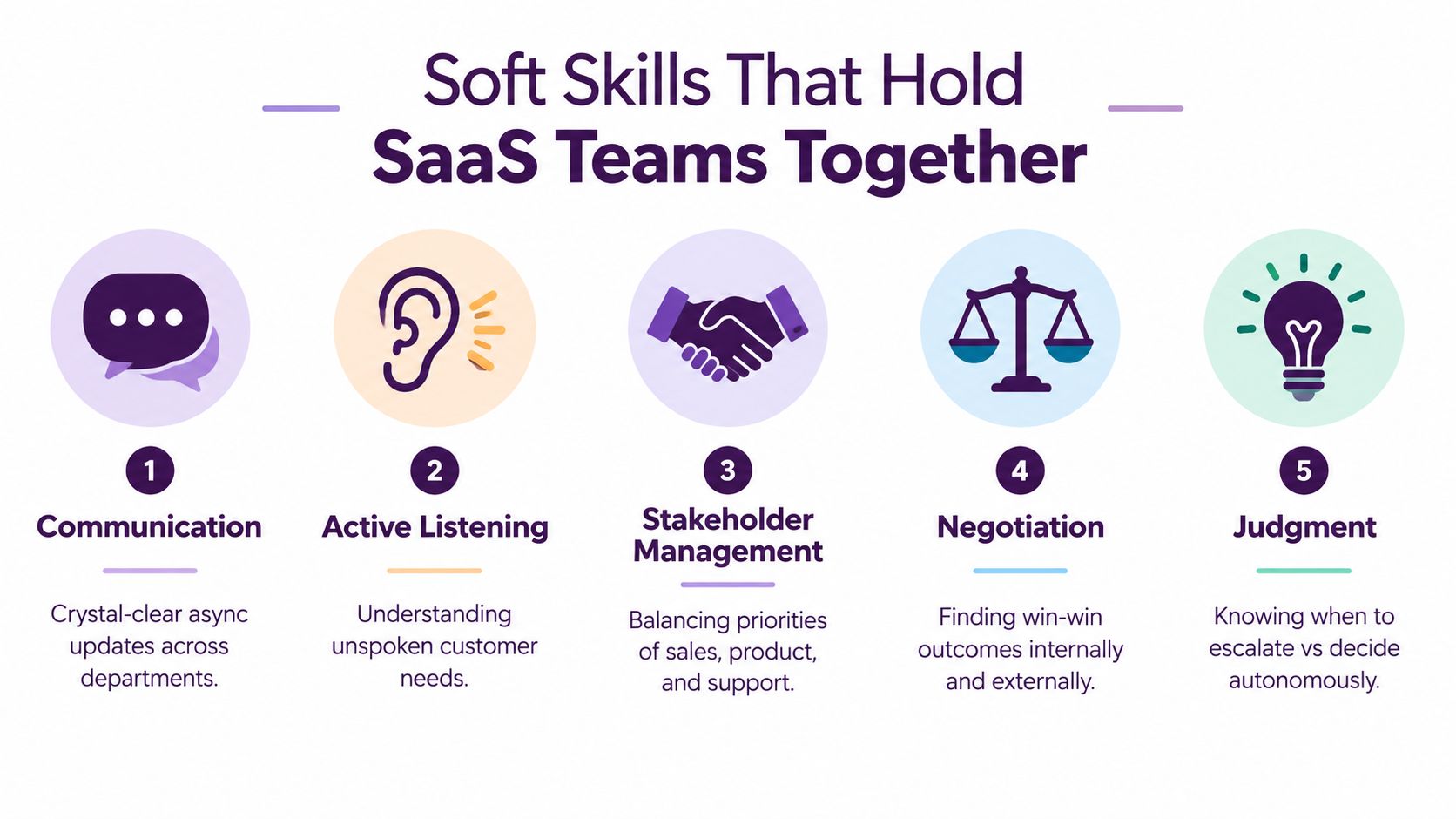
- Communication: Clear async updates beat long status meetings. In Slack, that means a useful message includes the issue, the owner, the risk, and the next step.
- Active listening: Customers often tell you the symptom, not the root problem. A CSM hears "the dashboard is confusing" and figures out the issue is trust in the underlying data.
- Stakeholder management: Product wants focus. Sales wants flexibility. Support wants stability. Someone has to hold all three realities at once.
- Negotiation: PMs negotiate roadmap trade-offs with engineering. Sales negotiates terms with buyers. Ops negotiates process changes with teams that already feel overloaded.
- Judgment: Good operators know when to decide alone and when to escalate fast.
What this looks like inside a SaaS workflow
A support lead on an enterprise outage call needs composure more than charisma. They need to acknowledge impact, avoid speculation, pull in engineering without noise, and keep customer trust steady while the facts are still emerging.
A product manager needs a different shape of soft skill. They may hear five loud requests from sales, two from CS, and one from the CEO. The job isn't to please everyone. It's to absorb the context, clarify constraints, and negotiate a path the team can ship.
Practical rule: If a handoff requires a follow-up meeting just to explain what the first person meant, the soft skill failed before the process did.
These abilities are teachable. They improve through call reviews, written handoff templates, better escalation rules, and sharper feedback. If your team wants a simple place to start, this piece on improving team communication in daily ops gets at the operational side of the problem.
Hard and Analytical Skills That Drive Decisions
Soft skills keep the machine connected. Hard and analytical skills tell it where to go.
In SaaS, people often confuse hard skills with tool familiarity. Knowing where to click in HubSpot, Looker, Salesforce, or Stripe helps, but that isn't the core thing. Skill is interpreting what the system is telling you and making a call someone can defend in a leadership meeting.
Why analytical thinking matters so much now
The clearest labor-market signal here is analytical thinking. In the World Economic Forum Future of Jobs reporting, summarized here, analytical thinking accounts for 9.1% of the core skills reported by companies, and UK employer research cited in the same source shows self-management accounts for 75% of skills gaps, while sales or customer service and management or leadership each account for 54%. That lines up with what happens inside SaaS teams. People need to read messy signals, stay disciplined, and then execute.
The finance side of this matters too. In the CGMA Competency Framework, advanced business-skill performance includes assessing the organizational environment and advising on strategic options, while the highest level requires expert knowledge to shape strategic vision. That's a useful way to see skill maturity. First you report. Then you interpret. Then you influence direction.
Hard and Analytical Skills Across the SaaS Skill Maturity Curve
| Maturity Stage | Core Skill | SaaS Example |
|---|---|---|
| Early | Data hygiene and reporting | A Sales Ops analyst cleans CRM stages so forecast reviews stop debating bad inputs |
| Developing | Metric interpretation | A CSM lead reviews churn cohorts and notices onboarding delays correlate with expansion risk |
| Intermediate | Financial and operational reasoning | A PM weighs engineering effort against likely retention impact before pushing a feature into the quarter |
| Advanced | Scenario analysis | A RevOps lead models how pricing changes could affect deal velocity, discounting, and support load |
| Strategic | Decision recommendation | A finance partner pressure-tests a new annual plan structure and recommends whether leadership should launch it |
What operators should actually train
Train people to answer questions like these:
- What changed: Did conversion drop because lead quality changed, the funnel broke, or reps started logging stages differently?
- What matters: Is this metric noisy, or does it justify a process change?
- What should happen next: Which owner needs to act, by when, and with what confidence level?
A team that wants better analytical habits usually needs tighter review loops, not more dashboards. This guide to monitoring and metrics for operating teams is useful if you're trying to build that muscle.
How Business Skills Differ Across Sales, Product, and Support
A common mistake is treating business skills like one universal checklist. In practice, each function uses a different stack.
Sales needs fast judgment near revenue. Product needs prioritization under ambiguity. Support needs calm execution under customer pressure. All three need communication, but they don't use it the same way and they don't combine it with the same hard skills.
Business Skill Mix by SaaS Function
| Function | Top Soft Skills | Top Hard or Analytical Skills | Where AI Augments |
|---|---|---|---|
| Sales Ops | Negotiation tone, stakeholder management, concise communication | CRM fluency, pipeline analysis, pricing logic, forecast judgment | Standardizes deal notes, flags approval mismatches, drafts follow-ups |
| Product | Listening, cross-functional alignment, trade-off judgment | Prioritization, SQL-style reasoning, usage analysis, effort-impact framing | Summarizes feedback patterns, organizes specs, keeps decision logs current |
| Support | De-escalation, empathy, expectation setting | Root-cause diagnosis, process documentation, queue triage, trend spotting | Suggests replies, routes issues, gathers context from tickets and product logs |
The shape of the role changes the shape of the skill
Sales Ops works close to motion and numbers. That team needs someone who can spot when a rep is using the CRM as a diary instead of a system of record. They also need the social skill to push back without creating political drag.
Product teams sit in the middle of competing truths. They need customer empathy, but empathy alone doesn't choose the roadmap. A strong PM converts noisy feedback into ranked decisions, then communicates why some requests won't make the cut.
Support is different again. The best support leaders aren't just fast responders. They diagnose patterns, document repeatable fixes, and calm customers while the rest of the company catches up.
If you're building outbound or early pipeline coverage, outside resources can help sharpen what that sales capability stack should look like. The team at Hire BDRs lays out practical expectations for business development roles in a way that's useful for founders staffing revenue functions for the first time.
Why Skill Gaps Are Now a Growth Bottleneck
The old model was simple. Hire smart people, give them a playbook, and expect the role to stay mostly stable for a while. That model doesn't hold up well in SaaS now.
Tools change fast. Customer expectations change faster. AI is changing task design across sales, support, operations, and product work. The bottleneck is often not headcount. It's the gap between what a person was hired to do and what the role now requires every week.
The evidence behind the bottleneck
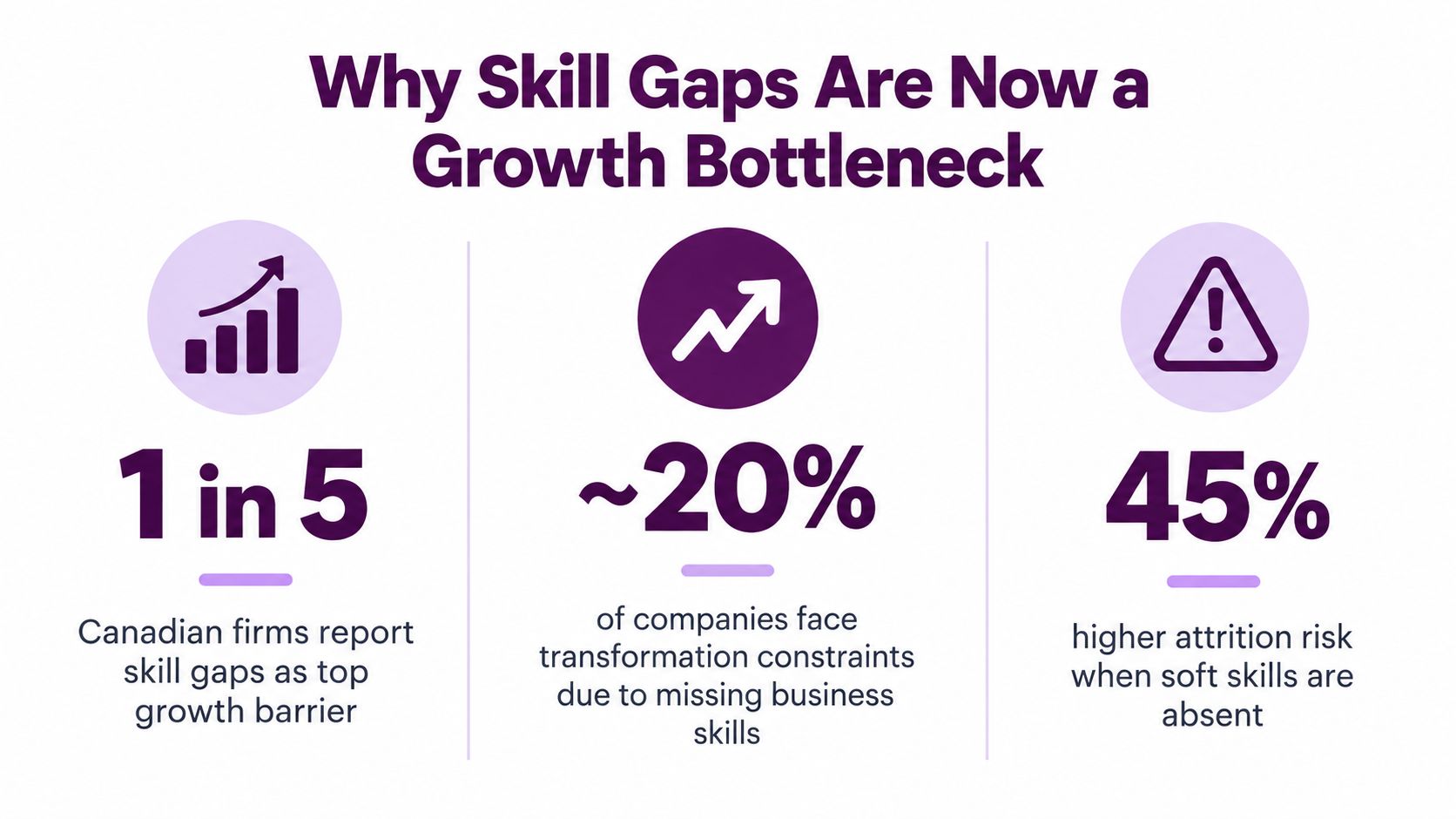
The strongest signal is that employers now treat skill building as continuous work. The UK Employer Skills Survey 2019 training report found 61% of employers had funded or arranged training for employees in the previous 12 months. Separately, the same verified data set notes the World Economic Forum has reported 60% of businesses say local labor-market skills gaps hold back business transformation. That moves the issue out of the HR bucket. It's an operating constraint.
The function-specific gap is getting sharper in AI-heavy work too. In Statistics Canada and UK AI labor market findings summarized here, 30.7% of businesses reported technical, practical, or job-specific skills as a gap, while 5.1% cited management skills and 5.4% cited basic digital skills. The same source says 97% of respondents identified at least one AI-related skills gap, with 57% reporting technical gaps and 30% non-technical gaps. It also notes that 85% of employers plan to upskill workers and 70% expect to hire for new skills over 2025 to 2030.
If your team still treats training like a quarterly event, your process will age faster than your hiring plan can fix.
A structured review helps. This competency gap analysis playbook is a practical resource if you want a cleaner way to map role demands against what the team can currently do.
A short walkthrough helps make the point in a less abstract way:
<iframe width="100%" style="aspect-ratio: 16 / 9;" src="https://www.youtube.com/embed/gpd7DLGmH_U" frameborder="0" allow="autoplay; encrypted-media" allowfullscreen></iframe>How AI Coworkers Operationalize Business Skills
When teams don't fail because they don't know what good looks like. They fail because good behavior depends on memory, individual discipline, and too much manual follow-through.
That's where AI coworkers become interesting. Not as replacements for judgment, but as a layer that makes judgment easier to repeat.
They carry standards into daily work
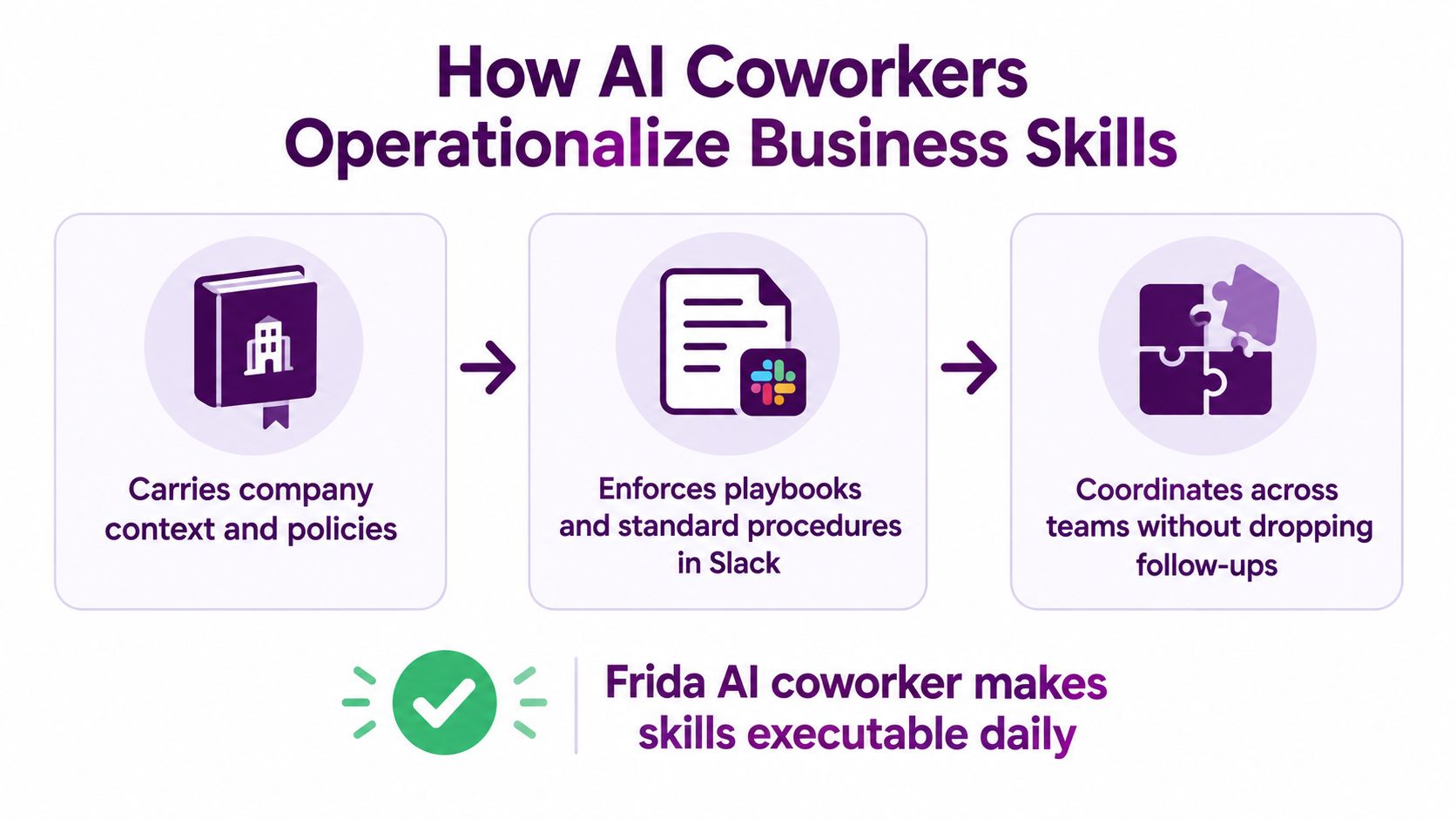
A good operator learns the company's tone, pricing rules, escalation thresholds, and customer habits over time. An AI coworker can hold that context and apply it consistently in the moment.
That means a support response can reflect the team's standard communication style. A renewal follow-up can include the right internal stakeholders. A discount approval request can follow the same logic every time instead of depending on who happened to be online in Slack.
Soft skills become operationalized. Not because the AI "has empathy" in a human sense, but because it can reinforce behaviors that support trust. Clear summaries. Timely follow-up. Consistent language. No dropped threads.
They work across tools without copy-paste chaos
A lot of business skill execution dies in the gap between systems. Someone sees churn risk in a BI dashboard, then forgets to update HubSpot, then means to ping CS, then gets pulled into another fire.
An AI coworker can bridge that. Inside Slack, it can pull data from CRM, billing, ticketing, docs, and product systems, then act on the result in the same thread. That's not a soft skill or a hard skill by itself. It's the enforcement layer that helps both stick.
For example:
- Customer risk workflow: Pull usage data, compare recent support volume, summarize the account, and post a recommended owner action.
- Sales process workflow: Check pricing rules, gather the latest deal context, and draft a compliant approval message.
- Product feedback workflow: Aggregate repeated complaints from tickets and CS notes, then package them into a cleaner signal for the PM.
They reinforce judgment patterns instead of replacing them
The most useful setup is one where the AI acts on behalf of the user, within that user's permissions, and leaves a visible trail. That way the team isn't outsourcing accountability. It's making good habits easier to repeat.
One option in this category is AI for business operations inside Slack. Supercenter's AI coworkers, including Frida, are built to live in Slack, execute work across connected tools, and carry reusable company skills such as process rules and response patterns. Used well, that kind of system helps teams turn training into behavior.
Strong business skills stop being abstract when the system itself nudges people toward the right next step.
The win isn't that AI knows everything. The win is that fewer important tasks depend on someone remembering the exact process under pressure.
Building a Skills-First Operating Rhythm for Your Team
If you want stronger business skills, don't start with a giant enablement program. Start with rhythm.
Teams improve when skills show up in ordinary work every week. A founder or ops lead can put that in motion quickly with a few simple rituals that don't require another standing meeting.
A weekly cadence that actually sticks
-
Monday skill of the week
Post one business skill in Slack. Keep it narrow. "Escalate with context, not urgency." "Turn dashboards into recommendations." "Summarize the customer ask before proposing a fix." Ask managers to reinforce it in live work. -
Wednesday decision review
Pick one recent call. Maybe a pricing exception, a roadmap trade-off, or a customer save attempt. Review what signal was available, what assumption was made, and whether the team used enough evidence. -
Friday handoff retro
Audit one messy transition between teams. AE to CSM. Support to engineering. Product to GTM. Don't turn it into blame. Turn it into a better checklist or template. -
Monthly skills audit
Keep a shared doc with role-specific skill stacks. Note where each team is strong, where they struggle, and which tasks now require AI literacy or system fluency that wasn't part of the role six months ago.
What leaders should look for
Watch for behavior, not just course completion.
- Clearer ownership: People know who decides, who contributes, and who needs visibility.
- Better recommendations: Analysts and managers don't just report metrics. They suggest actions.
- Stronger customer continuity: Handoffs carry context instead of forcing the customer to repeat themselves.
- Healthier AI use: People know when to use AI for speed, when to verify, and when human judgment should stay in front.
If you're tightening hiring around these patterns, a useful reference is this guide to sales hiring evaluations, especially for turning vague skill talk into observable criteria.
AI literacy belongs in this rhythm now. Not as a separate track for technical teams only, but as part of everyday business execution. The underlying shift is simple. Business skills are no longer just what your people know. They're also what your systems help them do reliably.
Supercenter gives teams AI coworkers that live inside Slack and do the work across connected tools while carrying company-specific skills, memory, and process context. If you're trying to make business skills more than training slides, it's a practical way to turn handoffs, follow-ups, and decision support into repeatable daily behavior. You can see how it works at Supercenter.
- business skills
- core business skills
- soft vs hard skills
- SaaS leadership
- AI coworkers