field notes
How to Improve Team Communication: A Practical Playbook
A standup starts with a simple status check and turns into a forensic exercise. Three decisions live in direct messages, a customer escalation sits in a Slack channel nobody watches, and a launch date shifts during a one to one without reaching the people building the release. Ev
A standup starts with a simple status check and turns into a forensic exercise. Three decisions live in direct messages, a customer escalation sits in a Slack channel nobody watches, and a launch date shifts during a one-to-one without reaching the people building the release. Everyone is communicating. The team still isn't aligned.
That pattern is why how to improve team communication is rarely solved by asking people to write friendlier messages or schedule more meetings. The fix is an operating system for information: clear channels, reliable rituals, visible ownership, traceable decisions, and automation that carries context between the tools where work happens.
Table of Contents
- Why Most Team Communication Playbooks Quietly Fail
- Diagnose the Real Communication Gaps in Your Team
- Set Communication Goals, Norms, and Decision Rights
- Rituals That Hold the System Together
- Put an AI Coworker to Work in Slack
- Measure What Matters Without Creating Spreadsheet Fatigue
- Pitfalls That Quietly Undo a Good Playbook
Why Most Team Communication Playbooks Quietly Fail
Most communication playbooks fail because they describe behavior without designing the system around it. “Be transparent” doesn't tell a product manager where a launch decision belongs. “Keep everyone updated” doesn't define who posts the update, when it appears, or what happens when an owner doesn't respond. “Use Slack effectively” doesn't stop a critical customer issue from disappearing inside a busy channel.
The manager layer makes this gap more serious. Gallagher's 2026 global employee communications research reports that 87% of internal communications professionals see manager effectiveness as a top risk, while only 21% provide managers with toolkits. The same research says 73% of organizations want a strategic communications model, but only 18% say they've achieved one. Those figures point to an execution problem, not a motivation problem.
A manager can care about clarity and still fail if the team has no channel architecture or decision rights. Under deadline pressure, people choose the fastest route. That usually means a DM, a quick call, or a private comment in a task. The message reaches someone, but the wider system loses the context.
Practical rule: If a communication norm depends on people remembering it during a crisis, it isn't a system yet.
At the two SaaS scale-ups where I rolled out communication playbooks, the durable changes were operational. We defined which messages belonged in Slack, which decisions belonged in a shared log, which updates could stay async, and which manager owned the handoff. A practical guide for managers can help with the interpersonal side, but manager skill only compounds when the surrounding workflow supports it.
The rest of the playbook follows that logic. First, identify where information breaks. Then establish norms and decision rights, install rituals that survive busy weeks, connect tools with an AI coworker in Slack, and measure whether decisions and handoffs move. The result should be a system your team can ship this quarter, not a poster of values that nobody checks after the kickoff.
Diagnose the Real Communication Gaps in Your Team
Start with evidence, not a workshop about communication styles. A useful diagnosis should end with named owners and dated fixes, rather than a slide deck describing how everyone feels.
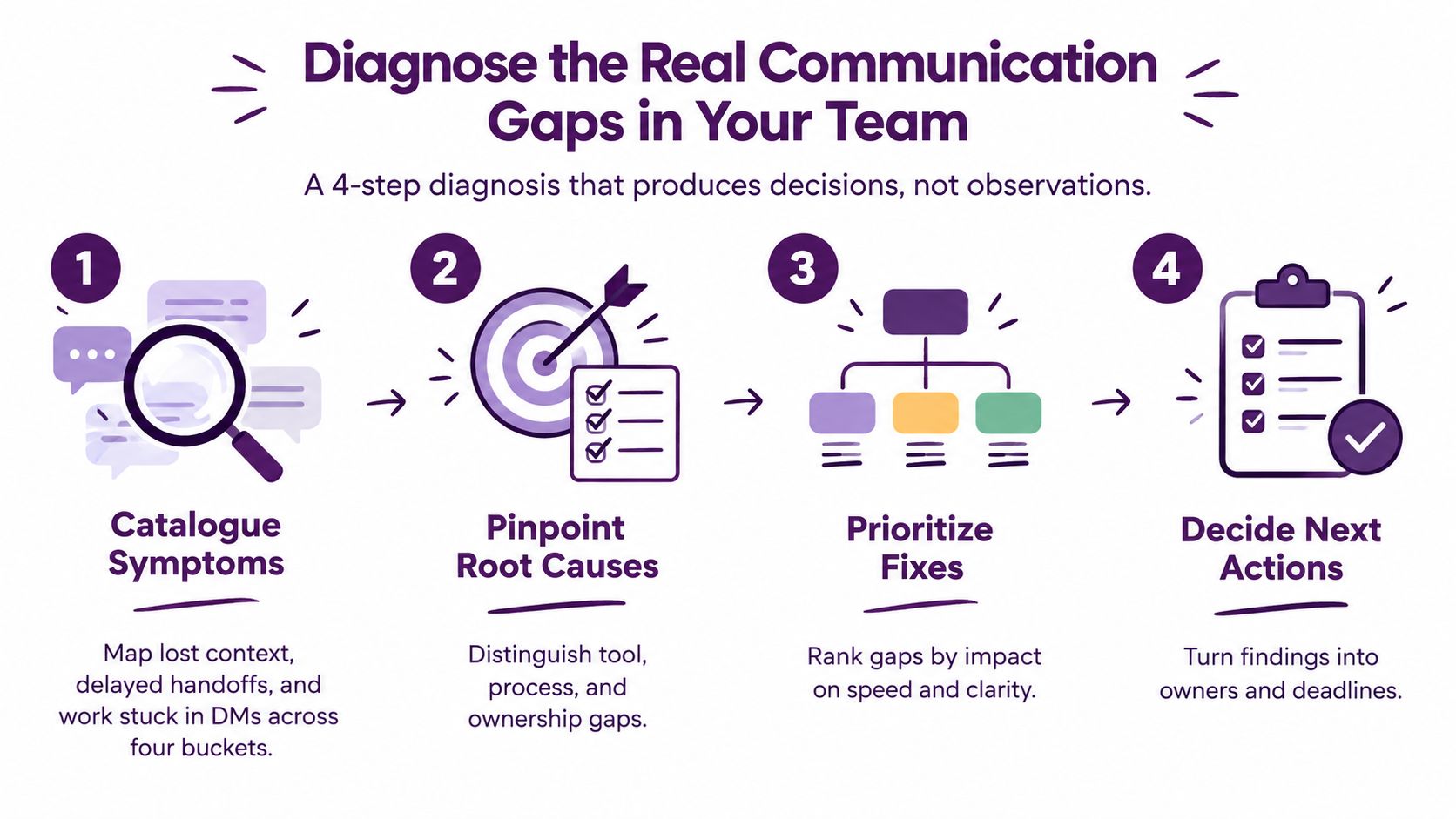
Map the symptoms
Catalogue breakdowns in four buckets:
- Lost context: decisions made in DMs, meetings without written outcomes, or tasks that lack the reasoning behind them.
- Delayed handoffs: work that stalls between design and product, product and engineering, or engineering and support.
- Duplicate work: two people solve the same problem because ownership or visibility is unclear.
- Escalation lag: a customer, technical, or delivery risk reaches the right owner only after it has become urgent.
Don't label these as personality problems. A quiet engineer may be working from incomplete information. A talkative manager may be compensating for a broken handoff.
Pull signals from existing work
Use Slack exports, ticket timestamps, meeting recordings, and a one-question Friday pulse. Ask the pulse question plainly: “What information did you need this week but couldn't find quickly?” Look for repeated paths, not isolated incidents.
Then interview the three people sitting at the worst handoff seams. Keep each conversation to 20 minutes and ask the same five questions:
- Where does work usually stop moving?
- What information is missing at that point?
- Which channel do people use instead?
- Who should own the next action?
- What small change would prevent the problem?
Comparable questions make patterns easier to spot and reduce the temptation to build the diagnosis around the loudest opinion. For additional context on distributed work, these resources for hybrid team communication offer useful practical prompts.
Turn findings into a one-page gap map
Use a simple four-column template:
| Symptom | Root cause | Owner | Proposed fix |
|---|---|---|---|
| Launch decisions stay in DMs | No decision-recording rule | Product lead | Log material decisions in the project channel |
| Support waits for release context | Engineering handoff is informal | Engineering lead | Post a four-line release handoff |
| Duplicate requests appear | No visible intake owner | Operations lead | Route requests through one channel |
Review the map in a 30-minute working session. Every row needs an owner and a target date. If the group can't assign either, the issue isn't ready to leave diagnosis. This map becomes the input for the norms charter, so keep it concrete enough to guide channel and ritual choices.
Set Communication Goals, Norms, and Decision Rights
Goals, norms, and decision rights belong in one operating layer. If you separate them, the team may agree to respond quickly without deciding which messages matter, or document decisions without clarifying who can make them.
Open a kickoff by choosing two communication goals tied to business outcomes. Examples include reducing handoff lag from 48 hours to 12 hours or reducing meeting time per engineer by 25%. Those examples are starting points, not universal targets. Use the gap map to choose goals your team can observe and influence.
Give every channel one job
A channel map should make the right behavior obvious:
| Channel Type | Purpose | Default Response SLA | Thread Rule |
|---|---|---|---|
| Project channel | Decisions, risks, and delivery coordination | Same working day | Keep replies in the original thread |
| Team updates channel | Recurring progress and announcements | Next working day | Start a new thread for each update |
| Incident channel | Time-sensitive operational response | Immediate during active incident | Keep actions and status changes in one thread |
| Direct message | Sensitive or genuinely private matters | Based on urgency | Move material decisions to the shared channel |
Use response expectations as service levels, not surveillance. An SLA should tell people what the team depends on, while preserving focus time for work that doesn't need an immediate reply.
Make decisions visible
Use a lightweight DACI model:
- Driver: prepares the decision and moves it forward.
- Approver: makes the final call.
- Contributors: provide relevant input.
- Informed: need the outcome, not a seat in every discussion.
Add thresholds based on reversibility, cost, and customer impact. A reversible implementation choice can move quickly with a small group. A customer-facing change or difficult-to-reverse commitment needs broader review.
A charter can follow this format:
Mission: How this team communicates to deliver its work.
Goals: Two measurable outcomes tied to execution.
Channel map: Purpose and owner for each channel.
Response SLAs: Expected response by message type.
Decision rights: DACI roles and escalation rules.
Review clause: Revisit the charter quarterly and publish changes.
Post the charter in a dedicated channel, walk through it at the team all-hands, and capture objections in the thread. Call the first version v1.1 after incorporating real feedback. A charter becomes useful when people can challenge it and still know where the current rule lives.
Rituals That Hold the System Together
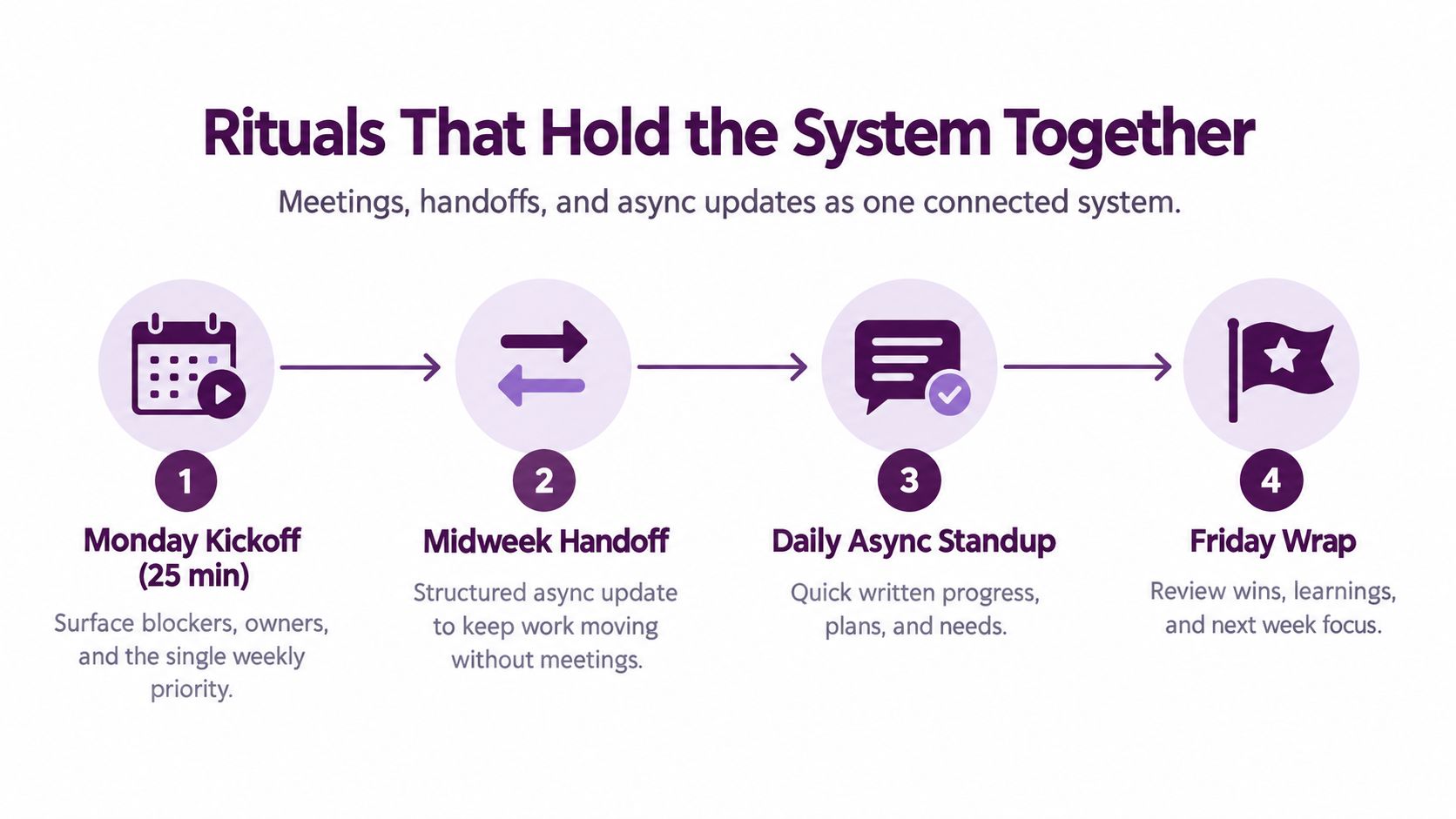
Meetings, handoffs, and async updates shouldn't compete with one another. They should form a weekly flow. Meetings handle ambiguity and decisions, async updates carry routine context, and handoffs transfer ownership at the exact boundary where work tends to stall.
Use a weekly operating rhythm
A practical cadence looks like this:
- Monday kickoff, 25 minutes: surface blockers, confirm owners, and identify the single decision each squad needs that week.
- Daily async update: post progress, plans, and needs in writing instead of using a status meeting by default.
- Midweek handoff: transfer work with a consistent script at each functional boundary.
- Friday close-out, 15 minutes: confirm decisions were logged and carryovers have current owners.
The Monday recap should reach the channel within an hour. That short delay matters because people who miss the meeting shouldn't have to reconstruct the week from scattered replies.
Copy the templates
Kickoff agenda
- What changed since last week?
- Which blockers need attention?
- Who owns each active risk?
- What is the one decision each squad needs?
- What will the written recap record?
Async update
Owner:
Status:
Risk:
Ask:
Ask people to post by 10:00 local time. The structure prevents status prose from replacing useful information. “Making progress” tells the team little. “API contract is ready, QA is blocked on test data, requesting an owner from data operations” gives someone a clear action.
Handoff script
What changed:
What happens next:
Who owns it:
What blocks it:
Use the script from design to product, product to engineering, and engineering to support. The receiving owner should reply with acceptance or a specific clarification. That reply closes the loop better than an assumption that silence means agreement.
For a lightweight start-of-day practice, these morning briefing ideas can help teams shape a concise written update without adding another meeting.
<iframe width="100%" style="aspect-ratio: 16 / 9;" src="https://www.youtube.com/embed/0BYQHoEsEHc" frameborder="0" allow="autoplay; encrypted-media" allowfullscreen></iframe>Put an AI Coworker to Work in Slack
An AI coworker is useful here when it closes the loop between conversation and execution. The important test isn't whether it can produce a polished summary. It's whether it can retrieve the runbook, inspect the relevant ticket, identify the owner, and reply in the thread where the request started.
A manager can pilot four patterns:
Summarize the project channel
Type:
@Frida /summarize #launch-product
The expected result is a thread reply containing recent decisions, owners, and open questions. The required setup is Slack access plus the project channels the coworker is allowed to read. The summary should point back to source messages, not replace them, so people can verify context.
Retrieve the runbook
Type:
@Frida /runbook incident escalation
Connect Notion or Confluence and define which workspace is authoritative. This pattern removes the repeated “who owns this?” search, but only if the runbook names an owner and an escalation path. An AI coworker can't repair documentation that has no accountable maintainer.
Route an alert
Type:
@Frida /alert when Jira priority changes to urgent or Sentry reports a production error, notify #on-call
This requires Jira and Sentry integrations, event permissions, and a destination channel with a clear on-call owner. Set boundaries before enabling automation. A noisy alert stream creates the same overload as a noisy channel, only faster.
Audit a channel
Type:
@Frida /audit channel #partnerships for last month
Connect Slack to the decision log or workspace where partnership records live. Ask the coworker to list decisions without owners, unanswered threads, and items that need confirmation. The manager still decides what to close. The coworker makes the review easier to start.
Tools such as Slack AI agent integrations can support this kind of workflow when the assistant works inside the conversation rather than forcing employees into another dashboard.
One option is Supercenter, which provides AI coworkers that live in Slack or Microsoft Teams, respond to @mentions, and carry out work across 2,000+ connected business tools. Its coworker model uses each requester's permissions, keeps an audit trail, and can apply reusable company skills across connected systems. Treat that capability as governed automation, not an excuse to skip channel ownership or documentation.
Measure What Matters Without Creating Spreadsheet Fatigue
Measurement should tell you whether communication moves work forward. It shouldn't create a second operations project that consumes the time the system was meant to protect.
Start with four metrics and review them monthly:
| Metric | Healthy Threshold | Owner | Reviewed |
|---|---|---|---|
| Meeting-to-decision ratio | Set a baseline, then improve it | Team lead | Monthly |
| Async response latency on shared channels | Set a median-hour baseline by channel | Channel owner | Monthly |
| Handoff completion rate | Define the required acceptance window | Functional lead | Monthly |
| Decision log coverage | Define which decisions are material | Operations owner | Monthly |
The thresholds need to come from your baseline and business needs. Don't copy another team's target. A support incident channel and a product planning channel should not have identical response expectations.
Define each metric precisely
Meeting-to-decision ratio equals decisions logged divided by recurring meetings held. A low result doesn't automatically mean the meeting is bad. It may mean the meeting exists for problem-solving, coaching, or relationship work. Use the metric to find recurring meetings with no clear purpose.
Async response latency should use the median time for a response on shared channels, not the number of pings sent. Counting pings rewards noise and encourages people to interrupt others instead of improving channel design.
Handoff completion rate tracks whether a handoff includes a named owner and an acceptance reply within the agreed window. It reveals whether work changed hands, rather than merely whether someone posted an update.
Decision log coverage measures whether material decisions include an owner and due date. The log should also show the decision status, source thread, and any review condition.
A 30-minute monthly review is enough:
- Review the four metrics.
- Select the largest recurring gap.
- Choose one experiment for the next month.
- Assign an owner and review date.
- Record the decision in the shared log.
A lightweight dashboard can be one page with the metric, current baseline, latest result, trend note, owner, and next experiment. Guidance on monitoring and metrics can help teams connect measurement to action without building an oversized reporting stack.
Pitfalls That Quietly Undo a Good Playbook
A communication system rarely collapses in one dramatic failure. It erodes through exceptions that become normal. Audit these patterns before the team concludes that the playbook “doesn't work.”
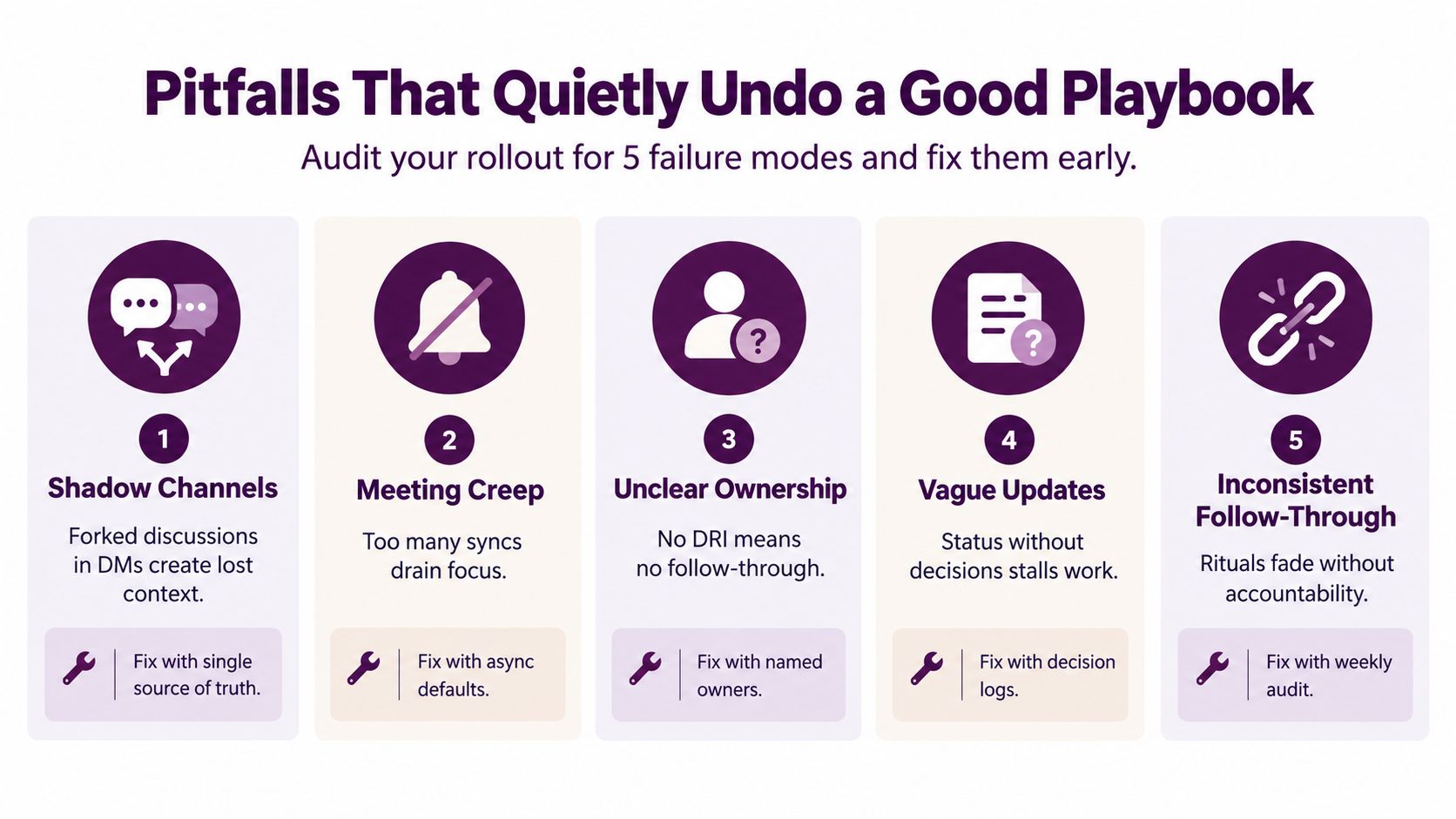
Shadow channels
Symptom: A decision appears in a DM or private group, then the public channel receives only the outcome.
Fix: Require a short decision record in the source-of-truth channel, including the approver, owner, and due date.
Leader's line: “What part of that decision needs to be visible to the people who'll execute it?”
Independent 2026 research reports that 62% to 65% of managers route around official channels using personal email or SMS, which makes shadow communication a governance issue rather than a minor preference. The findings are summarized in research on internal communications failure.
Async overload
Symptom: People miss the important update because every channel produces notifications.
Fix: Reduce duplicate posting, reserve urgent alerts for defined events, and make the daily update format predictable.
Leader's line: “Which notification can we remove while keeping the decision visible?”
Decision drift
Symptom: The team repeatedly debates a settled question because nobody can find the original reasoning.
Fix: Keep one decision log with an owner, date, status, and review condition.
Leader's line: “Are we changing the decision, or are we missing the record of the existing one?”
Calendar inertia
Symptom: A recurring meeting continues even when no decision is ready.
Fix: Replace it with an async update or cancel it for a trial period. Restore the meeting only when the work requires live discussion.
Leader's line: “What decision is on today's agenda that requires this room?”
Tool sprawl
Symptom: The team adds another app for intake, notes, alerts, or approvals without retiring an old one.
Fix: Assign one owner to the tool map and document what each system is authoritative for.
Leader's line: “Which existing workflow are we retiring if we add this one?”
Review the charter, channel map, decision log coverage, handoff completion, and recurring meeting list each quarter. If a ritual no longer supports a goal, change it. Communication improves when leaders treat the playbook as operating infrastructure, not as a permanent set of slogans.
Supercenter offers AI coworkers that work inside Slack or Microsoft Teams, connect conversations with tools such as Notion, Jira, Sentry, HubSpot, and Google Drive, and return completed work in the thread where someone asked. Visit Supercenter to see how an AI coworker can help your team preserve context, route follow-through, and make its communication system easier to run.
- team communication
- async work
- Slack productivity
- AI coworker
- leadership