Blogfield notes
Brand Voice vs Tone: A Practical Guide
You publish a confident product announcement, then watch the conversation move somewhere your style guide never reached. A prospect gets a warm, energetic email. A customer reporting a billing problem receives stiff, legalistic copy. An in product error sounds like it came from a
You publish a confident product announcement, then watch the conversation move somewhere your style guide never reached. A prospect gets a warm, energetic email. A customer reporting a billing problem receives stiff, legalistic copy. An in-product error sounds like it came from an entirely different company, while an AI-generated follow-up adds cheerful filler nobody on your team would use.
That's the practical problem behind brand voice vs tone. Your company needs a recognizable personality, but it also needs to respond appropriately when the situation changes. The answer isn't to make every message sound identical. It's to define what must remain stable, what can flex, and how people and AI systems apply those rules without improvising from scratch.
Table of Contents
- Why Your Brand Sounds Different in Every Channel
- The Core Differences Between Voice and Tone
- Real-World Examples Across Customer Channels
- When to Bend the Rules Without Breaking Trust
- Building a Governance System for Your Guidelines
- Encoding Standards for Human Teams and AI Coworkers
- Turning Your Brand Identity into an Active System
Why Your Brand Sounds Different in Every Channel
A SaaS company can sound polished in a campaign and careless five minutes later in its support inbox. The marketing team talks about momentum and possibility. Support responds to an angry customer with, “Please be advised that your request has been escalated in accordance with our procedures.” Both teams may believe they're being professional, yet the customer hears two unrelated personalities.
That disconnect usually starts with a simple mistake: teams treat voice and tone as interchangeable. They write a list of adjectives such as friendly, bold, and trustworthy, then ask every department to “sound on-brand.” The marketing team interprets friendly as playful. Legal interprets trustworthy as formal. Product interprets concise as abrupt. Each interpretation becomes a local dialect.
Brand voice is the stable character behind the communication. It reflects how the company thinks and what it values. A brand might be direct, thoughtful, practical, and encouraging. Those qualities should still be recognizable in a landing page, a support reply, a product notification, and an executive update.
Brand tone is the situational expression of that character. Tone changes with the audience, channel, topic, and emotional state. A launch email can be energetic. A payment warning should be calm and clear. A response to a service disruption should be measured and accountable. The personality stays intact, while the delivery adapts.
Practical rule: Keep the company's character consistent, but never force the same emotional temperature onto every customer situation.
This distinction is also a communication problem inside the business. Teams need shared language for deciding whether a draft is off-brand or using an appropriate tone for a difficult moment. A practical team communication framework can help establish that shared operating language, especially when marketing, support, product, and operations all publish customer-facing messages.
The distinction matters because channel growth creates more opportunities for drift. A company can preserve its identity only when it documents the stable principles first, then defines the acceptable variations for recurring situations.
The Core Differences Between Voice and Tone
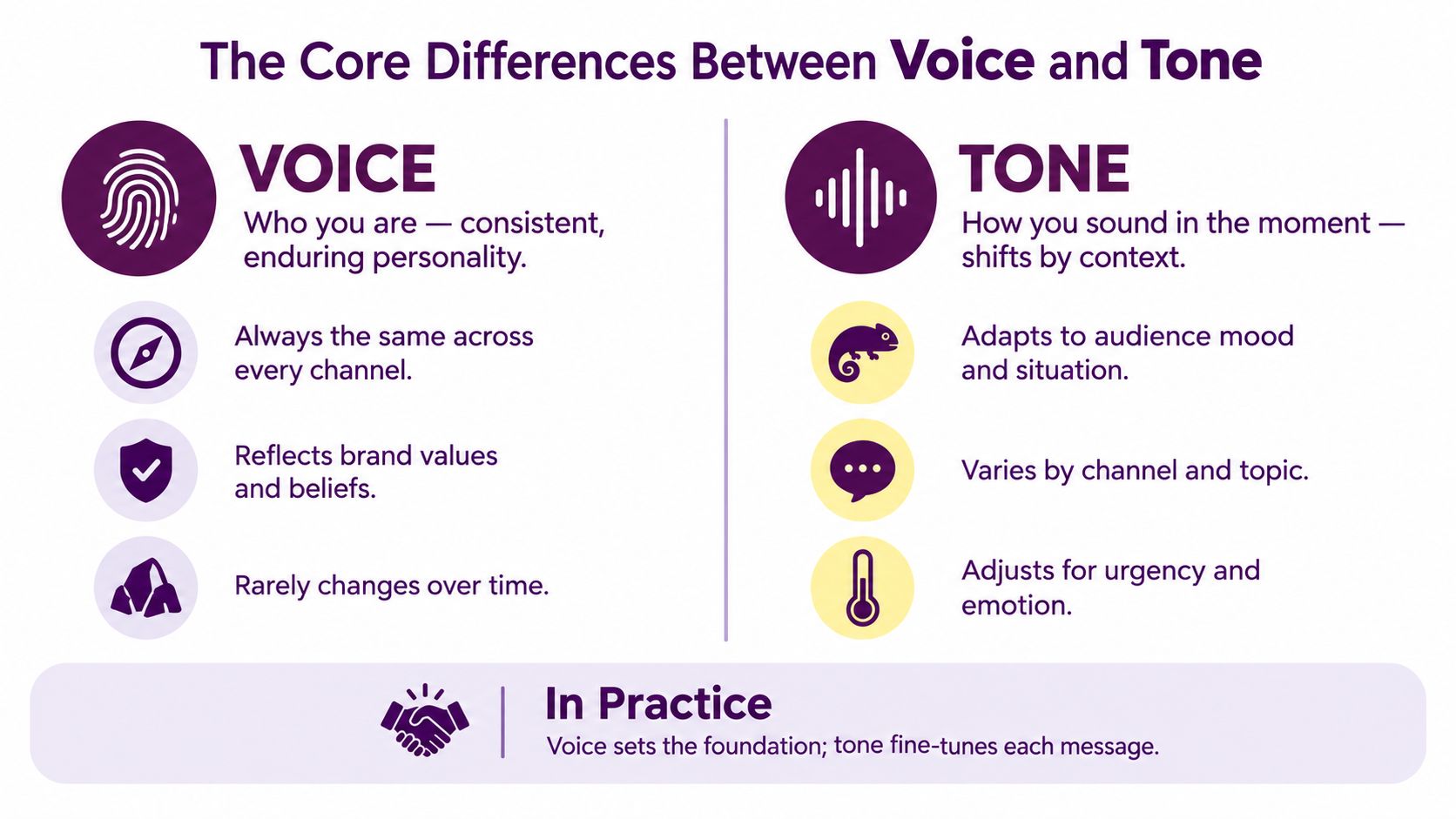
Voice answers, “Who are we when we communicate?” Tone answers, “How should that personality sound right now?”
Think of voice as the structure and tone as the adjustment. Voice gives writers a consistent point of view, vocabulary, and attitude. Tone changes the amount of energy, warmth, formality, urgency, or restraint in a particular message.
The difference isn't merely theoretical. A 2018 empirical study in the Journal of Interactive Marketing analyzed social-media tone and found that, in Study 1a with 174 participants, a human voice rather than a traditional corporate voice increased consumers' hedonic value and purchase intentions. The study provides a measurable basis for treating tone as a commercial factor, not just a copywriting preference. Read the study details and publication record.
Voice sets the permanent constraints
A voice guide should make it possible to recognize your company without seeing the logo. It might specify that the brand is:
- Direct, not abrupt: State the decision and the reason without burying either in corporate phrasing.
- Knowledgeable, not condescending: Explain complexity in plain language without treating the reader like a beginner.
- Encouraging, not overexcited: Help customers move forward without adding hype to ordinary tasks.
Tone then applies those boundaries to the moment. The same direct and knowledgeable voice might become optimistic in a product launch, reassuring in an error message, and careful during a billing dispute.
| Attribute | Brand Voice | Brand Tone |
|---|---|---|
| Role | Defines the brand's personality | Adjusts the expression for the situation |
| Stability | Remains recognizable across channels | Changes by audience, topic, and emotional context |
| Main question | Who are we? | What does this person need from us now? |
| Examples | Direct, curious, practical | Warm, measured, urgent, reassuring |
| Governance | Documented as enduring principles | Specified through scenarios and channel rules |
| Failure mode | Generic or indistinct identity | Tone drift or inappropriate emotional intensity |
A useful test is to remove the logo and compare messages from different teams. If the language feels like different companies, the voice isn't defined clearly enough. If every message has the same energy, the tone system is probably too rigid.
The best guidelines therefore separate identity traits from situational settings. Voice tells the writer what the brand will never become. Tone tells the writer how much of that personality to bring forward in the moment.
<iframe width="100%" style="aspect-ratio: 16 / 9;" src="https://www.youtube.com/embed/n2bkLqDrw58" frameborder="0" allow="autoplay; encrypted-media" allowfullscreen></iframe>Real-World Examples Across Customer Channels
Consider a SaaS company with a voice that is straightforward, capable, and encouraging. That voice can work across the customer journey, but the tone should change as the customer's needs change.
Marketing copy should create momentum
A product launch can use a warm, energized tone:
You can now automate the weekly report that used to take an afternoon. Connect your data, choose the audience, and send a clear update without rebuilding the process each time.
The voice remains practical and confident. It doesn't need inflated claims, excessive exclamation marks, or a sudden shift into startup slang. The tone gives the message more forward motion.
For email, the subject line should match the same decision. A concise product announcement may call for a clear, sentence-case subject, while a celebratory customer milestone can justify more warmth. Teams that need a quick editorial reference can use these subject line capitalization best practices to keep the mechanics consistent without confusing formatting rules with brand personality.
Support replies should reduce friction
A customer whose payment failed doesn't need the launch tone. They need clarity, accountability, and a next step:
Your payment didn't go through, so the workspace is still active while you update the card. Check the billing details and try again. If the problem continues, reply here and we'll help you resolve it.
The company is still encouraging and direct. It hasn't become cold or evasive. What changed is the emotional setting. The message avoids celebration, jokes, and promotional language because those choices would make the customer feel ignored.
A support reply should answer three questions in order:
- What happened?
- What can the customer do next?
- What will the company do if that doesn't work?
Product messages need precision
In-product copy has less room for personality, but it still carries voice. An empty state might say:
No reports yet. Create your first report to see the metrics your team checks most often.
An error message could read:
We couldn't load this report. Try again, or check your connection if the problem continues.
The tone is calm and matter-of-fact. The voice appears through the choice of plain language, useful instructions, and respect for the user's time.
Platform differences matter too. A LinkedIn post may use more context and formality than a TikTok comment, while a notification needs tighter wording than either. Those are tone adjustments, not permission to invent a new personality for every platform.
When to Bend the Rules Without Breaking Trust
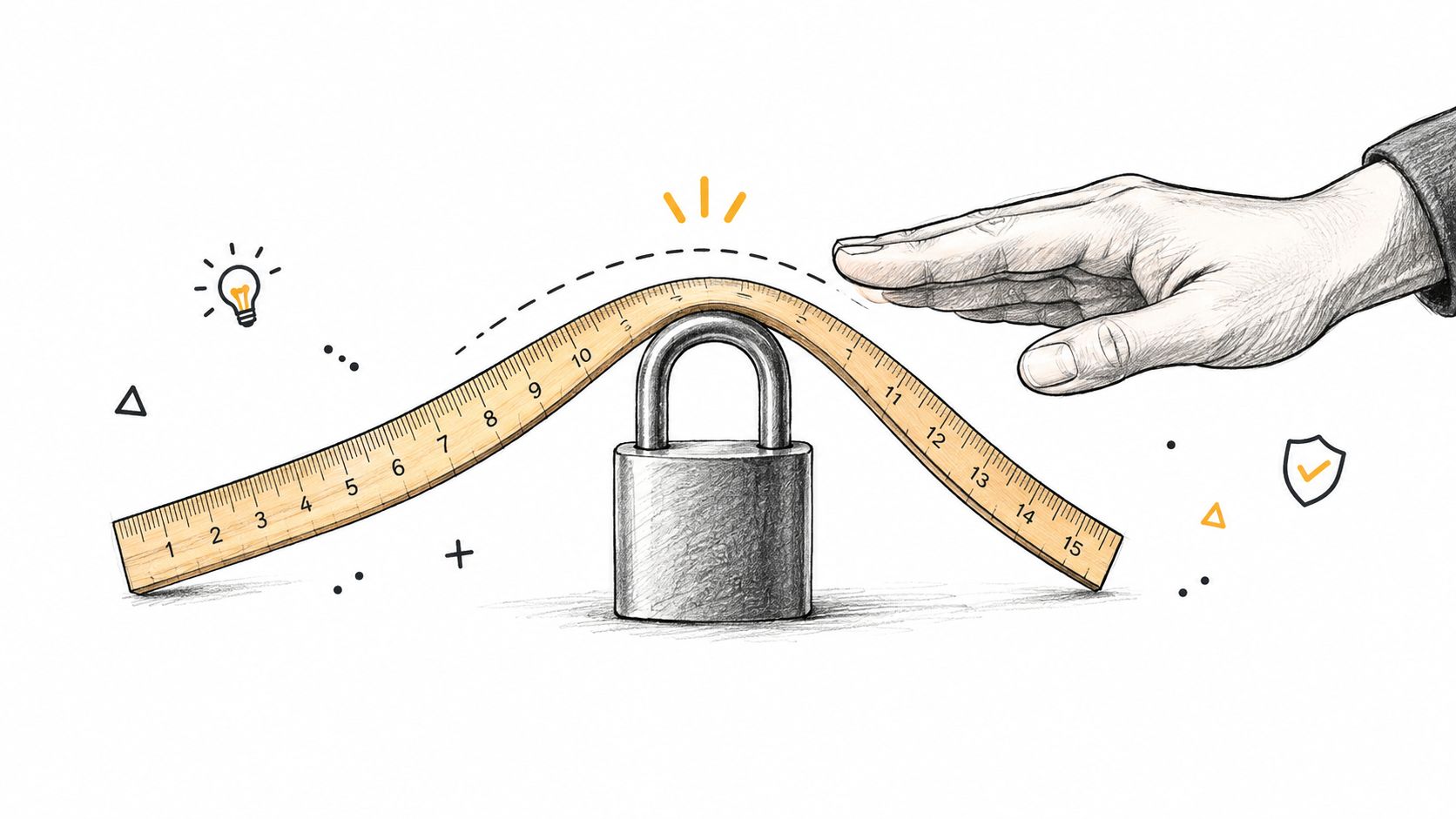
Tone flexibility has a boundary. If a brand changes its emotional stance so far that customers can't recognize its underlying character, adaptation becomes identity drift.
The risk is highest in moments where customers evaluate intent, not just information. Billing disputes, security incidents, service failures, and sensitive support cases all require more restraint. A playful brand can still be human in a crisis, but humor may signal that the company hasn't understood the seriousness of the situation.
Use the context test
Before changing tone, ask what the customer is carrying into the interaction:
- High emotion: Acknowledge the impact before explaining the process.
- High urgency: Put the action and current status near the beginning.
- High uncertainty: Separate confirmed facts from what the team is still investigating.
- High consequence: Remove jokes, hype, ambiguity, and unnecessary persuasion.
The brand's voice should remain visible through honesty, clarity, and respect. What changes is the amount of energy and informality.
Authenticity is an operational constraint
A 2025 Voices report found that 61% of respondents said voice and audio set the tone for marketing materials and campaigns, while 36% said voice personalizes customer experience. The report also describes a preference for natural, human voice over AI voices because of authenticity and ethical concerns. Review the report's findings.
That evidence supports a practical conclusion: customers don't experience tone as decoration. They use it to judge whether a message feels attentive, appropriate, and trustworthy. An AI-generated response can be grammatically clean and still fail if it sounds generic, overly enthusiastic, or emotionally detached.
A reliable boundary is this: bend the tone to meet the customer's situation, but never bend the values behind the voice. If your brand is candid, don't hide a service problem behind cheerful wording. If it's respectful, don't turn a frustrated customer into a punchline. If it's practical, don't replace a clear next step with emotional performance.
Building a Governance System for Your Guidelines
A PDF in a shared drive isn't a governance system. It's reference material, and reference material fails when a writer is working quickly, a support lead is handling an escalation, or an AI tool is generating content from a vague prompt.
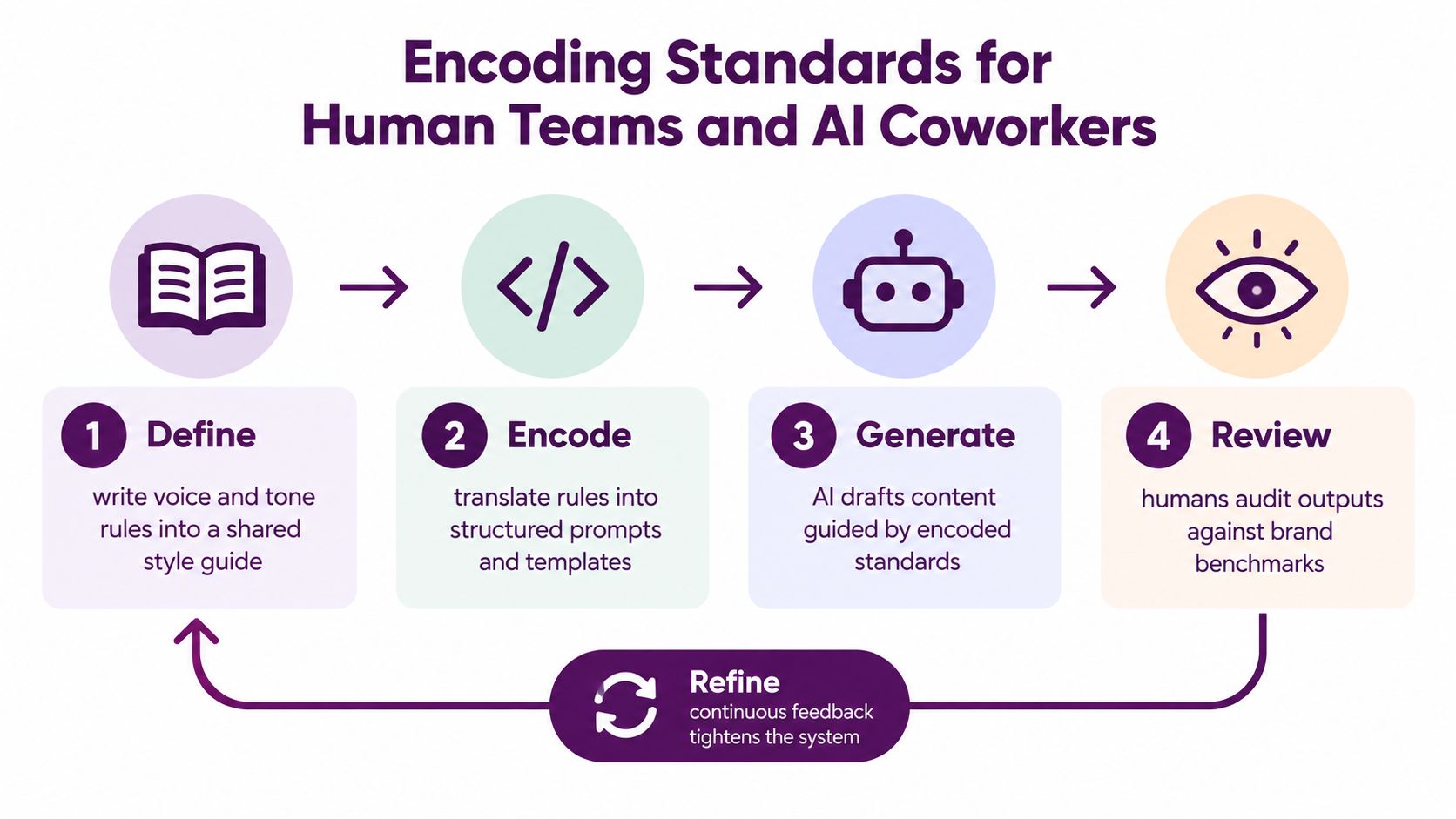
Your system needs four layers: a stable voice definition, scenario-based tone rules, examples that show the boundaries, and a review process that turns mistakes into updates.
1. Define the voice as decisions
Start with your audience, values, and language. Audit a sample of website copy, support replies, product messages, sales emails, and social posts. Score each channel against:
- Target audience: Does the wording reflect how customers describe their problem?
- Brand personality: Can readers identify the company's character?
- Core values: Does the message demonstrate those values, rather than merely naming them?
- Audience language: Are technical terms explained where necessary?
- Overall consistency: Would the same company plausibly have written every example?
Avoid a list of attractive adjectives without constraints. “Friendly” doesn't tell a writer whether to use humor, contractions, or informal greetings. Define each trait with a permitted behavior and a clear boundary.
2. Map tone to recurring situations
Create scenario cards for launch announcements, onboarding, support recovery, billing, outages, product education, and executive communication. For each card, specify the desired tone on practical axes such as funny versus serious, formal versus casual, respectful versus irreverent, and enthusiastic versus matter-of-fact.
A tone card should also identify prohibited moves. For an outage, that might include jokes, speculative promises, and promotional calls to action. For onboarding, it might prohibit dense technical language and unexplained acronyms.
3. Build examples and review ownership
Write approved and rejected examples side by side. A writer learns faster from “Use this instead” than from a paragraph about brand spirit.
Assign ownership for reviewing the guide, approving exceptions, and updating scenario cards. The person accountable for brand governance should work with marketing, product, support, and legal, because voice problems often appear at the handoffs between those functions.
A living system also needs accessibility checks. Plain language, descriptive labels, readable structure, and useful error messages make the brand easier to understand for more people. A guide such as information accessibility principles belongs beside voice guidance, not in a separate universe, because clarity is both a user experience standard and a brand behavior.
Encoding Standards for Human Teams and AI Coworkers
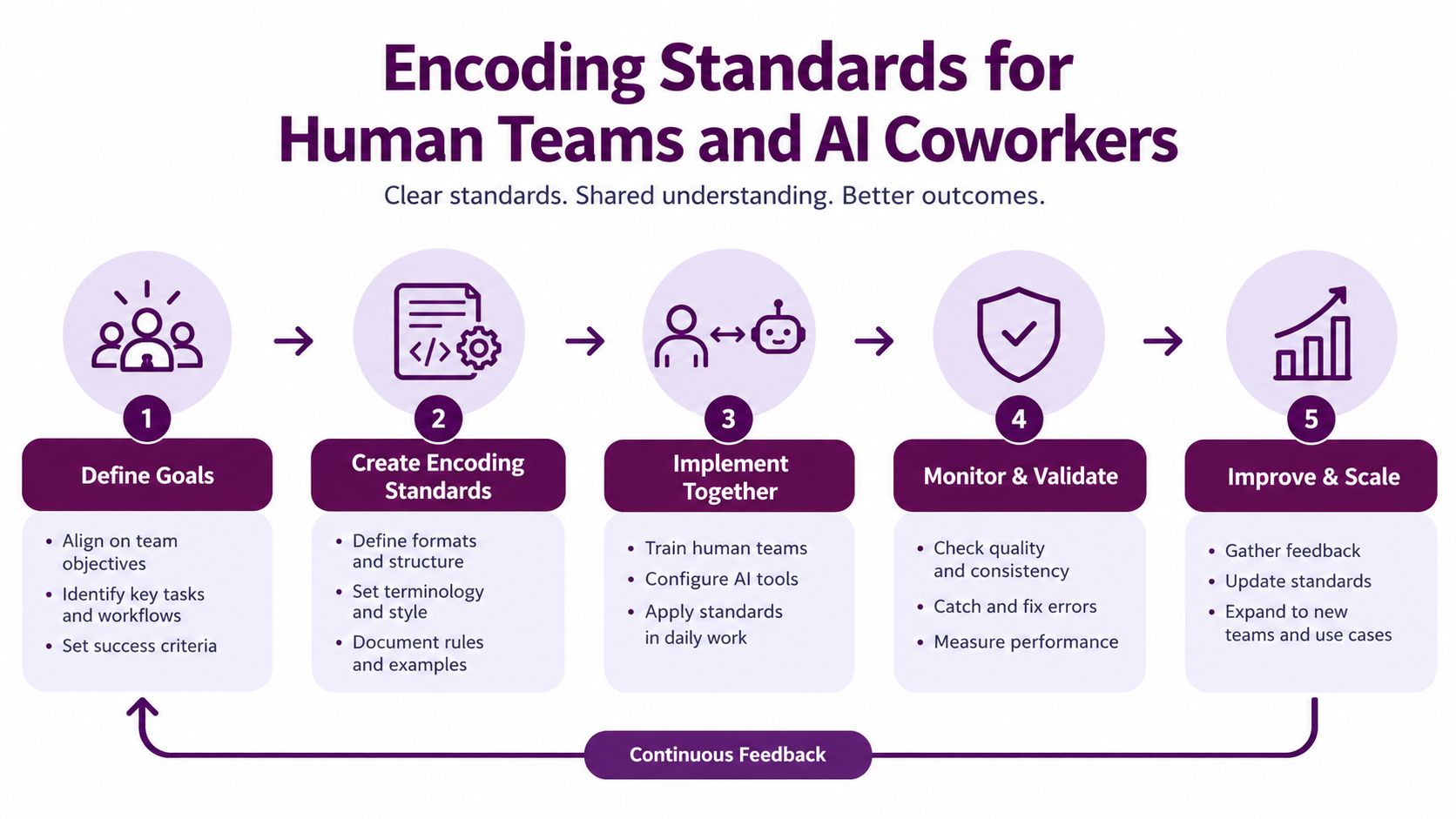
AI creates a new version of an old governance problem. Humans used to improvise off-brand language in isolated channels. AI can reproduce a weak instruction across many workflows unless the team encodes the standard clearly.
The fix isn't to tell an AI tool to “sound more like us.” That instruction is too vague. Give the system a structured operating brief with the brand's point of view, voice traits, prohibited patterns, scenario rules, and examples.
Store rules as reusable skills
A useful AI voice skill should include:
- Identity rules: The company's enduring personality and principles.
- Tone selection: Which scenario the request belongs to and how the delivery should change.
- Language rules: Preferred terms, forbidden clichés, sentence preferences, and formatting.
- Evidence rules: What the system may claim, what requires a source, and what it must leave qualitative.
- Escalation rules: When a human must review before sending.
That structure lets an AI distinguish between drafting a celebratory campaign email and responding to a customer whose account access is blocked. The same voice governs both outputs, but the scenario changes the emotional setting.
Give humans a reviewable workflow
Human review should focus on judgment, not basic cleanup. Ask reviewers:
- Does the draft express the brand's stable character?
- Did it select the right tone for the situation?
- Does it make claims the source material supports?
- Does it give the reader a clear next step?
- Would the message feel respectful if the customer were already frustrated?
An AI coworker such as Supercenter can keep reusable company skills, including brand voice standards, and apply them while working across connected business tools. That model is relevant when teams want instructions to travel with the work instead of being pasted into every request. Teams formalizing adoption can also use AI training for employees to teach people how to delegate, review, and escalate AI-assisted tasks.
The important design choice is separation of duties. The AI can draft, retrieve context, and apply approved rules. People should own exceptions, sensitive decisions, and changes to the standard.
Version the system like a product
Treat voice and tone rules as maintained assets. Record why a rule changed, which channels it affects, and which examples demonstrate the new behavior. When a support escalation reveals that “warm” sounds patronizing in a particular situation, update the scenario card instead of relying on a reminder in a team meeting.
Turning Your Brand Identity into an Active System
Brand voice isn't a slogan and tone isn't a mood board. Together, they form a decision system that tells people and machines how to communicate under changing conditions.
Start with a short voice definition. Name the traits, connect each trait to a behavior, and define what the trait does not mean. Then create tone rules for the situations your teams handle repeatedly, from product launches to billing problems and service recovery.
Audit the system across the actual customer journey:
- Marketing: Does the message create the right energy without hype?
- Support: Does it acknowledge the customer's situation and provide a next step?
- Product: Does it stay concise, clear, and useful?
- AI output: Can a reviewer identify the rule behind each wording choice?
If your guidelines can't answer those questions, they're not ready to scale. Turn them into reusable examples, structured prompts, scenario cards, and review criteria that your teams can apply in daily work. The goal isn't for every message to sound the same. The goal is for every message to sound like it came from the same company, even when the moment demands a different tone.
Supercenter provides AI coworkers that work inside Slack and Microsoft Teams, connect with business tools, and carry reusable skills such as proposal standards, pricing rules, and brand voice guidance. Visit Supercenter to see how your team can turn communication standards into repeatable workflows for people and AI coworkers.
- brand voice vs tone
- brand guidelines
- AI communication
- content strategy
- brand identity