Blogfield notes
What Is Anomaly Detection: A Practical Guide for SaaS Teams
You open the dashboard before the first meeting and see daily active usage falling off a cliff. Stripe shows an unfamiliar billing spike. Support tickets look heavier than usual. Nobody has reported an incident, but the numbers are loud enough to make the whole team uneasy. That'
You open the dashboard before the first meeting and see daily active usage falling off a cliff. Stripe shows an unfamiliar billing spike. Support tickets look heavier than usual. Nobody has reported an incident, but the numbers are loud enough to make the whole team uneasy.
That's the operational problem behind what is anomaly detection. It isn't a promise that every unusual data point represents a crisis. It's a way to distinguish meaningful changes from normal variation, then route the changes worth investigating to someone who can act.
Table of Contents
- When Metrics Spike and Nothing Seems Wrong
- What Anomaly Detection Actually Means in Business
- Supervised vs Unsupervised Anomaly Detection
- Real Anomalies SaaS and Revenue Teams Should Monitor
- How to Implement Anomaly Detection Without Overcomplicating It
- Why Anomaly Detection Alone Is Not Enough
- Turning Anomalies Into Action With an AI Coworker
When Metrics Spike and Nothing Seems Wrong
The first reaction is usually manual. Refresh the dashboard, compare yesterday with the previous week, check a product release, ask engineering whether an event pipeline failed, and search Slack for a customer complaint. By the time someone has assembled enough context, the underlying issue may already have affected renewals, usage, or reporting.
A hard threshold can help, but it only knows the boundary you gave it. A rule such as “alert when signups fall below a fixed value” may miss a gradual decline, while a broad rule can fire during every weekend, holiday, campaign, or planned release. Teams end up choosing between late alerts and noisy alerts.
Anomaly detection changes the question. Instead of asking whether a metric crossed an arbitrary line, the system asks whether the current observation fits the behavior expected for that metric, account, segment, or time period. The answer can still be wrong, but it gives the investigation a more useful starting point.
Operational rule: An alert earns its place when someone knows what to check next.
For revenue teams, that context matters. A billing change might be a legitimate annual renewal, a duplicate event, a failed proration, or a tracking problem. If you're investigating a Shopify-related revenue decline, diagnosing revenue loss for Shopify offers a useful way to structure that investigation around concrete causes instead of dashboard anxiety.
The same principle applies to broader metric hygiene. A practical guide to monitoring and metrics can help you define which signals deserve a baseline, who owns them, and what counts as a response. Detection is only the first handoff. The value appears when the team can move from “something changed” to “we know who is checking why.”
What Anomaly Detection Actually Means in Business
Anomaly detection identifies rare or unusual events that don't conform to expected behavior. That definition comes from the field's current understanding of the problem, where systems examine data for deviations rather than relying only on predefined business rules. The 2024 survey of anomaly detection methods describes the field in those terms and shows how it has expanded across a broad benchmark ecosystem.
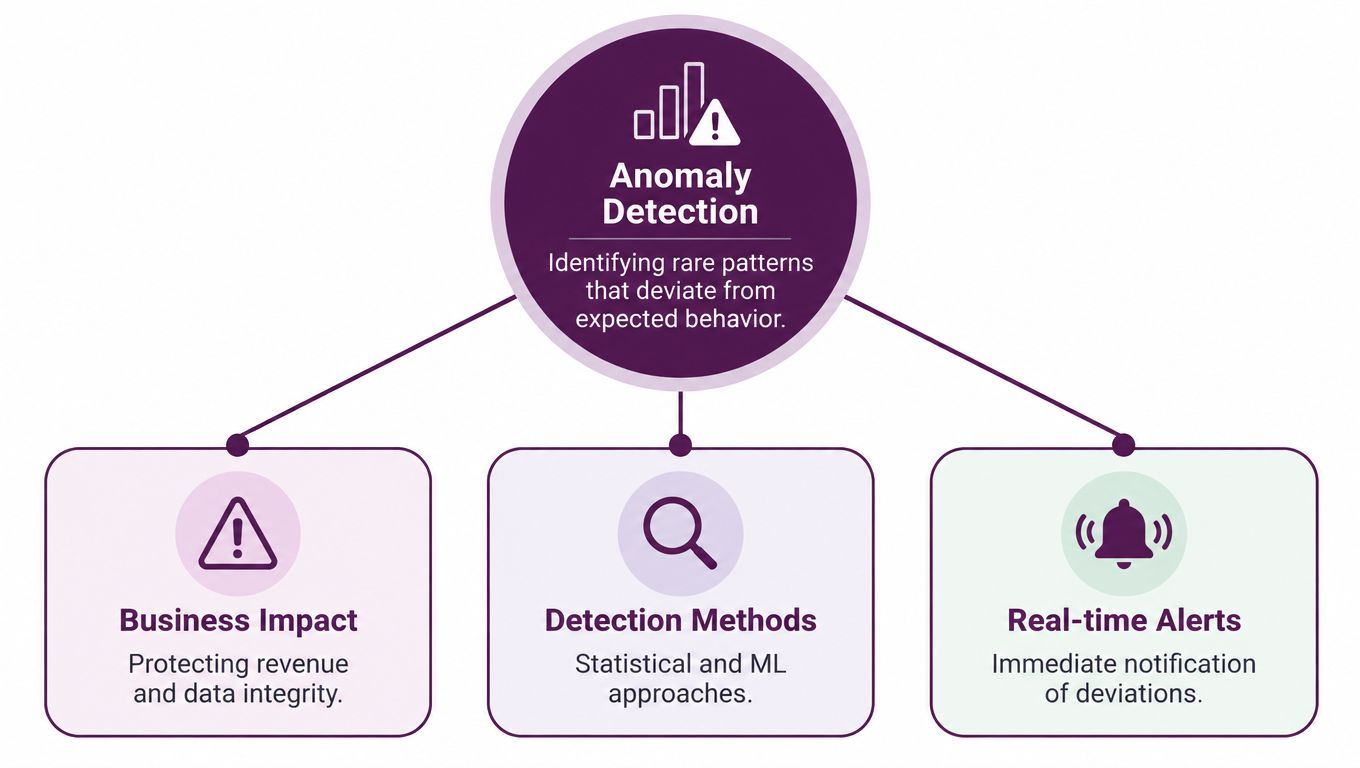
A business detector usually performs three jobs:
- Model expected behavior. It learns or receives a baseline for a metric, event stream, customer segment, or operational process.
- Measure deviation. It compares new observations with that baseline, often across several variables rather than one number.
- Prioritize investigation. It produces a score, category, or alert that helps a person decide whether the event deserves attention.
Consider product usage. A customer's login count may be lower on a weekend, so a simple comparison with the previous day could produce noise. A more useful detector considers the account's normal usage pattern, recent product changes, plan type, and related signals such as support activity. A sharp change across several relevant signals becomes more interesting than one isolated low value.
The same logic applies to revenue operations. An unusual invoice amount might reflect a valid contract change, while a set of invoices with the same unexpected pattern could indicate a data or billing issue. Teams working with revenue recognition may also need a clear understanding of ASC 606 for SaaS founders, because a statistical anomaly and an accounting error aren't interchangeable conclusions.
The process can run in batches or on incoming events. The right speed depends on the cost of delay. A suspicious login, payment event, or broken data feed may need immediate attention, while a weekly pipeline review can tolerate slower analysis.
This short video provides a visual introduction to anomaly detection concepts and workflows:
<iframe width="100%" style="aspect-ratio: 16 / 9;" src="https://www.youtube.com/embed/OS9xRGKfx4E" frameborder="0" allow="autoplay; encrypted-media" allowfullscreen></iframe>Supervised vs Unsupervised Anomaly Detection
The practical distinction is simple. Supervised detection learns from labeled examples, while unsupervised detection looks for unusual structure without requiring every past anomaly to be labeled.
Supervised models can work well when your team has a reliable history of incidents. If you've consistently labeled fraudulent payments, failed integrations, or genuine churn-risk events, the model can learn the difference between those outcomes and ordinary activity. The weakness is that labels are expensive and often inconsistent. Revenue teams rarely have a complete, trustworthy record of which unusual events were truly important.
Unsupervised methods fit environments where normal behavior changes and labeled incidents are scarce. The system identifies deviations from patterns in the data, which makes it useful for discovering issues nobody anticipated. The trade-off is investigation effort. An unsupervised alert is usually a lead, not a verdict.
Research history supports that practical preference. A review of time-series anomaly detection found that 65% of methods proposed between 1980 and 2000 were unsupervised, and research activity increased sharply after 2016 following a relatively stable period from 1990 to 2016. Those findings are documented in the time-series anomaly detection review.
Choosing between supervised and unsupervised anomaly detection
| Approach | When It Works Best | Key Trade-off |
|---|---|---|
| Supervised | You have consistent labels for known incidents and a stable definition of failure | It can be precise for known patterns, but misses problems outside the labeled history |
| Unsupervised | You have limited labels, changing behavior, or a need to discover unfamiliar issues | It surfaces novel deviations, but often creates more work to validate alerts |
| Hybrid | You can combine learned patterns with business rules and reviewed outcomes | It can balance discovery and control, but requires clearer ownership and ongoing tuning |
Start with unsupervised detection when the question is “what changed?” Use supervised detection when the question is “does this resemble a known incident?” Add rules where the business already knows the answer, such as an impossible state or a contractual limit.
Real Anomalies SaaS and Revenue Teams Should Monitor
The useful monitoring surface is wider than a single revenue chart. SaaS teams generate signals across product usage, billing, customer behavior, support, and the funnel. The goal isn't to flag everything unusual. It's to identify deviations that could change a decision or require an owner.

Usage signals
A sudden drop in active usage for one account may indicate adoption trouble, a broken integration, or a tracking defect. A change across many accounts could point to an outage, a release regression, or an instrumentation problem. The alert should include the affected segment and the last known normal period, not just a red line on a chart.
A steady decline is often more valuable than a dramatic one-day dip. It can reveal that customers are using fewer core features before they mention a problem or enter a renewal conversation.
Billing and revenue signals
Billing anomalies deserve careful context because valid commercial events can look strange. Watch for unexpected changes in subscription charges, duplicate invoice events, unusual discount application, failed payment patterns, or a mismatch between product usage and billed activity.
A detector shouldn't automatically label these events as fraud or revenue leakage. It should gather the relevant account, invoice, plan, and recent change information so finance or operations can confirm the cause without rebuilding the case manually.
Funnel and service signals
Unusual support-ticket volume can indicate a product problem, a confusing release, or a customer segment struggling with the same workflow. A sudden change in lead-to-opportunity movement may reflect a campaign effect, routing failure, or CRM data issue. A sharp shift in win reasons or sales-cycle stages can also expose inconsistent data entry.
Use severity based on consequence and actionability. A harmless seasonal shift needs a note or no alert. A billing pattern that blocks collection, affects reporting, or threatens customer trust needs an owner, supporting evidence, and a defined next step.
How to Implement Anomaly Detection Without Overcomplicating It
Start with a metric your team already reviews and a response someone can actually perform. “Monitor everything” creates an unowned queue. “Monitor renewal-risk usage for strategic accounts” creates a tractable operating process.
Build the baseline before choosing the model
Document the expected behavior first. Decide which dimensions matter, such as account, plan, geography, weekday, product area, or lifecycle stage. Record planned releases, campaigns, billing runs, and known reporting gaps so the detector doesn't learn temporary noise as normal.
Then choose the simplest method that can answer the question. A fixed rule works for a physically impossible value or a contractual boundary. A rolling statistical baseline can handle changing levels. A machine-learning model becomes more useful when several variables interact and a simple rule cannot represent the pattern.
Your data pipeline matters as much as the detector. If events arrive late, duplicate, or without the account context needed for investigation, a more sophisticated model won't rescue the workflow. A practical overview of real-time data integration is useful when you're deciding how fresh the inputs need to be.
Tune for the alert budget
Anomaly detection is usually an extreme class-imbalance problem. That means a model can rank observations well while still producing too many false positives at the threshold your team uses. The precision and recall analysis of anomaly detection explains why AUC-ROC and average precision are common ranking metrics, but why production teams should also examine precision, recall, and F1 at the chosen threshold.
Use the evaluation report to answer operational questions:
- How many alerts can the owner review? Set the threshold around capacity, not an abstract score.
- What does a missed anomaly cost? A payment issue and a minor usage fluctuation shouldn't receive the same tolerance.
- Which alerts lead to action? Track reviewed, dismissed, confirmed, and resolved outcomes.
- When does behavior change? Revisit the baseline after pricing changes, launches, migrations, and major customer mix shifts.
Model drift is unavoidable in changing SaaS data. Recheck alert quality when the underlying process changes, and preserve the context needed to explain why the detector fired.
Model complexity isn't a reliable shortcut to better operations. A benchmarking study found that a tree-based approach achieved perfect recall on 13 datasets and ranked first overall across 40 multivariate datasets, as reported in the comparative anomaly detection benchmark. The lesson is practical: test lightweight tree-based methods when your data is tabular, sparse, or nonlinear before committing to a deep-learning stack.
Why Anomaly Detection Alone Is Not Enough
A score is not a response. If an alert lands in a dashboard without an owner, evidence, or a decision deadline, the team has gained another notification rather than better control.
Rule-based monitoring still earns its place in specific contexts. A deterministic rule is fast to understand, cheap to operate, and easy to audit. If a payment status is invalid or a required event is missing, you may not need a model. You need a clear condition and a reliable route to the person responsible.
Machine learning earns its keep when the expected pattern is contextual, multivariate, or difficult to describe in advance. It can help identify a customer's changing usage profile or an unfamiliar combination of billing and product events. But it adds tuning, explanation, drift management, and review work.
The model should reduce investigation time, not outsource judgment to a score.
A smaller team should usually start with rules and lightweight baselines, then add ML where the rules repeatedly fail. Industry coverage describes a shift toward machine-learning-based, real-time, cloud-based detection, while also reporting that large enterprises held 62.41% of the market in 2025, according to Mordor Intelligence's anomaly detection market overview. That adoption pattern doesn't mean every company needs the same architecture. It highlights the deployment gap between having data and having the people to operate a model.
Slack changes the economics of follow-up because the alert can appear where the team already discusses customers, incidents, and revenue. An effective message names the anomaly, shows the comparison, explains the likely context, tags the owner, and asks for a specific decision. The system should also record what happened after the alert, so repeated false positives become tuning inputs rather than permanent background noise.
Turning Anomalies Into Action With an AI Coworker
Anomaly detection becomes operational when the system closes the loop between signal and responsibility. The alert should reach the channel where the relevant work happens, carry enough evidence to support a first judgment, and remain attached to the follow-up until someone confirms the cause.
An AI coworker can support that workflow inside Slack. It can monitor selected metrics, compare activity with an agreed baseline, pull related records from systems such as Stripe, HubSpot, Salesforce, or a data warehouse, and flag the appropriate owner with context. It can also keep the investigation visible in the thread instead of forcing the team to maintain another dashboard.
The difference is memory and continuity. A useful coworker should know the company's naming conventions, escalation standards, customer segments, and reporting definitions. It should remember open tasks and prior decisions, while respecting the permissions of the person who requested the work. The team still makes the judgment, but it no longer starts every investigation from a blank screen.
Research activity in time-series anomaly detection remained relatively stable from 1990 to 2016 before increasing sharply after 2016, while unsupervised methods represented 65% of methods proposed between 1980 and 2000, according to the review of time-series anomaly detection. The technical progress matters, but the operating model matters just as much. Detection has to fit the way people receive, discuss, assign, and resolve work.
For teams evaluating an AI business assistant, the practical test is straightforward. Can it explain why the alert appeared, find the supporting records, identify the owner, create or update the follow-up, and preserve an auditable trail? If not, it may be adding another layer between the signal and the decision.
Start with one high-value workflow, such as declining usage in renewal accounts or irregular billing events. Define the baseline, the acceptable alert volume, the owner, and the resolution states. Once the team trusts that loop, expand detection carefully. Proactive monitoring works when every alert has a reason to exist and a person prepared to act.
Supercenter provides AI coworkers that work inside Slack and Microsoft Teams, connect with 2,000+ business tools, monitor metrics, and route context-rich follow-ups to the right owner. Visit Supercenter to see how your team can turn anomaly alerts into accountable operational work.
- anomaly detection
- SaaS monitoring
- AI anomaly
- revenue operations
- business metrics