Blogfield notes
Enterprise Rules for AI Coworkers
The popular advice is to write better enterprise policies. That's only half the job. A policy sitting in a wiki can guide a careful employee, but it can't reliably control an AI coworker moving from Slack to HubSpot, Google Drive, Stripe, Jira, or a finance system. For that, ente
The popular advice is to write better enterprise policies. That's only half the job. A policy sitting in a wiki can guide a careful employee, but it can't reliably control an AI coworker moving from Slack to HubSpot, Google Drive, Stripe, Jira, or a finance system. For that, enterprise rules need to become runtime instructions, with permissions, approvals, exceptions, and auditability built into the action itself.
This distinction matters because AI agents don't merely answer questions. They create records, send messages, update deals, route leads, schedule meetings, and trigger workflows. If the rule exists only as prose, the agent has to interpret it at the moment of execution. That's where operational risk begins.
Table of Contents
- Rethinking Enterprise Rules for the AI Era
- Why Manual Policy Enforcement Is Failing
- Real-World Examples of Enterprise Rules in Action
- Moving from Static Documents to Runtime Execution
- Encoding and Managing Rules in Supercenter
- Building a Graduated Enforcement Strategy
Rethinking Enterprise Rules for the AI Era
Most companies still treat enterprise rules as documents. They live in an employee handbook, a compliance portal, a Notion page, or a folder of PDFs that people consult when something feels uncertain. That model was already difficult to maintain across departments. It becomes inadequate when an AI coworker can act across a broad business stack without waiting for a human to translate policy into each individual step.
Enterprise rules are better understood as the operating logic of the company. They determine who may approve a discount, which customer data can move between systems, when a support issue needs escalation, how expenses are categorized, and what happens when the normal path doesn't apply. Documentation explains the intent. Runtime enforcement determines whether the intent survives contact with actual work.
This is consistent with how formal governance has evolved. Eurostat's enterprise data governance methodology treats the enterprise as a measurable unit made up of one or more legal units, with management and production factors considered when determining how that unit should be represented. The practical lesson is simple: governance needs a clear object, clear boundaries, and repeatable treatment across jurisdictions and operating units.
An AI coworker needs the same clarity during onboarding. It needs to know the company's proposal style, but also which information it can retrieve, which actions require confirmation, and which requests must be declined or escalated. A useful introduction to the broader governance questions is F1Group's guide to AI governance frameworks, particularly for teams mapping accountability around autonomous systems.
Documents explain intent, rules control action
A written sentence such as “discounts above the approved threshold require sales leadership approval” leaves several operational questions unanswered:
- Who counts as sales leadership?
- Which customer segment does the rule cover?
- Where should the approval be recorded?
- What happens if the approver is unavailable?
- Can an agent prepare the quote, or must it stop before doing anything?
Machine-actionable enterprise rules answer those questions in a form that can travel with the workflow. They separate the decision criteria from the interface where a person or agent happens to request the work.
That's the difference between an AI coworker and a chatbot. A chatbot can generate a plausible answer. An AI coworker must understand context, use the requester's permissions, execute a sequence, and leave behind evidence of what happened. For a practical definition of that operating model, see what an AI coworker is.
Practical rule: If a policy can't tell an agent what to do, what it can't do, and when to ask for help, it isn't an execution rule yet.
The strongest enterprise rules are reusable. A pricing rule should work whether a salesperson asks in Slack, a workflow starts in HubSpot, or an agent receives an instruction from a scheduled process. Centralized business logic avoids re-implementing the same decision in every application, which is the approach described in Decisions' platform overview. The point isn't centralization for its own sake. It's consistency at the moment work happens.
Why Manual Policy Enforcement Is Failing
Manual enforcement fails because humans are being asked to act as the integration layer between policy and an expanding collection of tools. Someone must remember the rule, locate the current version, interpret the exception, check the requester's authority, perform the action, and document the result. That process breaks down quickly when work crosses departmental boundaries or runs at machine speed.
PwC's Global Compliance Survey 2025 surveyed 1,802 executives across 63 territories. Eighty-five percent said compliance requirements had become more complex during the previous three years, while 77% said that complexity had negatively affected growth-related activities. The same survey found that 49% were already using technology for 11 or more compliance activities, a strong signal that enterprises are moving enforcement into software rather than relying only on manual review.
The geographic spread of that survey also matters for multinational companies. Respondents represented Europe, North America, Asia Pacific, Latin America, the Middle East, and Africa, so the underlying problem isn't confined to a single regulatory environment. A rule that works in one region may need different data handling, approval ownership, or retention treatment somewhere else.
Why spot checks don't scale
Spot checks work when activity is limited and predictable. They don't work when an agent can perform several dependent actions in one request. Reviewing the final output may not reveal that the agent used the wrong data source, skipped an approval, or applied an outdated customer classification along the way.
The operational failure usually looks ordinary:
- A sales representative asks for a revised proposal in Slack.
- The agent retrieves account information from a CRM.
- It applies a pricing adjustment.
- It saves a document to a shared drive.
- It sends the proposal to the customer.
- A manager later discovers that the discount needed approval.
The problem isn't just the final document. It's the missing control between steps three and four. Manual review arrives after the irreversible action, which turns governance into incident response.
Manual review is a useful safety net. It shouldn't be the primary mechanism that makes routine work compliant.
Complexity creates an agility tax
Teams often respond to policy friction by creating workarounds. They copy data into personal spreadsheets, use unapproved AI tools, or ask colleagues to perform actions through accounts with broader access. Those shortcuts may feel faster, but they make ownership and audit trails harder to reconstruct.
A runtime rule can check the relevant conditions before execution. It can route an approval, limit the fields exposed to the agent, or stop the action while returning a useful explanation. That approach reduces the need for employees to memorize every exception and gives operations teams a way to improve the control without rewriting every workflow.
Real-World Examples of Enterprise Rules in Action
Enterprise rules become easier to design when you start with ordinary decisions rather than abstract governance language. Consider a sales team preparing a proposal in HubSpot. The agent can collect the customer's plan, region, contract status, and requested terms, then prepare the document. The enterprise rule decides whether it may send the proposal or must request approval first.
A sensible implementation separates preparation from commitment. The agent can draft a price and explain the calculation, but the send action remains conditional on the customer segment, discount context, and approver role. That gives salespeople speed without allowing an assistant to turn an informal request into an unauthorized commercial commitment.
Pricing approval in practice
The rule might be expressed operationally as follows:
- Standard terms: Draft and route the proposal to the assigned account owner.
- Nonstandard terms: Add the reason for the exception and request the designated approval.
- Sensitive customer state: Stop the workflow and notify the responsible revenue operations owner.
- Approval completed: Save the approval record, update the CRM, and send the approved version.
The value comes from using the same decision logic in every entry point. A human can request the work in Slack, an automation can start it from HubSpot, or an AI coworker can prepare the package from a sales channel. The approval condition shouldn't change because the interface changed.
Expense policy inside Slack
Expense enforcement offers a different pattern because employees often submit incomplete context. An agent may receive a receipt and a short message such as “Please file this.” The rule needs to identify the expense category, project or cost center, currency, receipt status, and requester's organization.
For routine purchases, the agent can classify the receipt and prepare the submission. If a required field is missing, it should ask one targeted question rather than reject the entire request. If the expense conflicts with policy, it should explain the reason and route the exception to the correct owner.
That last step matters. A hard refusal teaches the employee nothing and encourages a manual workaround. A guided exception preserves the control while keeping the work moving.
Territory-based lead routing
Lead routing shows why enterprise rules need explicit ownership. The agent may receive a new lead from a form, a shared inbox, or a Slack message. It can check geography, account size, industry, language, existing ownership, and current lifecycle stage before assigning the record.
A reusable routing rule avoids the common failure where two systems make different assignments. It should also define what happens when the data is incomplete. The correct result may be a holding queue with a reason code, not a random assignment based on the first available salesperson.
When reviewing an informal process, ask three questions:
- What decision is being made?
- Which facts change the outcome?
- What must happen when the facts are missing or contradictory?
Those questions turn tribal knowledge into a rule that an employee, application, or AI coworker can apply consistently.
Moving from Static Documents to Runtime Execution
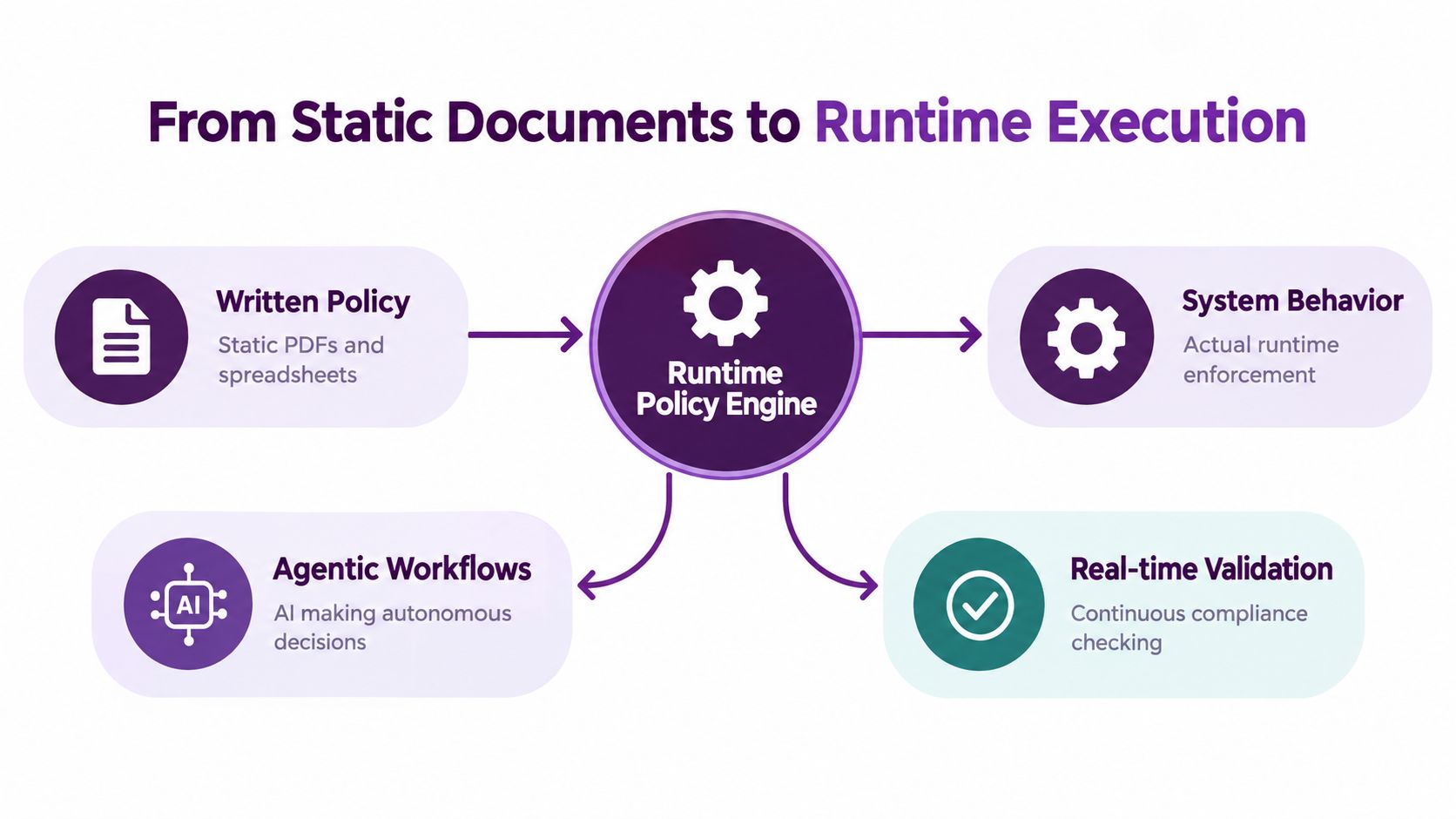
The gap between written policy and system behavior is where most AI governance programs become fragile. A policy may say that only authorized employees can approve a transaction, but the execution layer must verify the requester, the connected account, the target system, and the requested action at runtime.
For regulated automation, the technical foundation usually includes role-based access control, single sign-on, and immutable audit logging. I3 Solutions' workflow automation guidance describes the control model clearly: authorized users should be the only people able to create, approve, or modify workflows, while decisions, system calls, approvals, overrides, and rule changes should be time-stamped and retained for review.
The rule must travel with the action
An AI agent often crosses application boundaries in a single task. It may read a customer record, calculate an outcome, create a document, update a CRM, and notify a channel. If the rule exists only inside one application, the agent can leave the control boundary as soon as it calls another tool.
A runtime execution layer keeps the business decision attached to the workflow. It checks the user's authority before the action, applies the relevant policy to the data and destination, and records the result afterward. This doesn't require every rule to be hard-coded into every integration. It requires a shared way to evaluate the rule wherever the action occurs.
The distinction is important:
| Static policy model | Runtime enterprise rules |
|---|---|
| Explains what employees should do | Evaluates what the system may do |
| Lives in a document or portal | Travels with the workflow |
| Depends on interpretation | Uses explicit conditions and outcomes |
| Finds problems after execution | Can block, route, or request approval before execution |
| Records policy intent | Records the decision and its evidence |
AI governance becomes an execution problem
Recent coverage of governance in the agentic era frames governance as a continuous lifecycle that connects policy definition, enforcement, and risk discovery. That framing fits operational reality. An agent may behave safely in one context and require tighter controls in another because the user, data, destination, or requested action has changed.
Runtime rules should therefore evaluate more than the text of a request. They should consider:
- Identity: Who initiated the task, and which permissions do they hold?
- Intent: Is the request informational, preparatory, or committing an external change?
- Data: Does the task involve personal, financial, confidential, or restricted information?
- Destination: Which system or person will receive the result?
- Approval: Has the required owner approved this exact action?
- Evidence: Can a reviewer reconstruct what the agent saw and did?
That final point separates useful logging from decorative logging. A timestamp alone doesn't explain a decision. Reviewers need the request, relevant inputs, rule version, action sequence, approval state, and outcome.
A policy is complete only when an operator can reconstruct why the agent acted, not merely confirm that it acted.
Encoding and Managing Rules in Supercenter
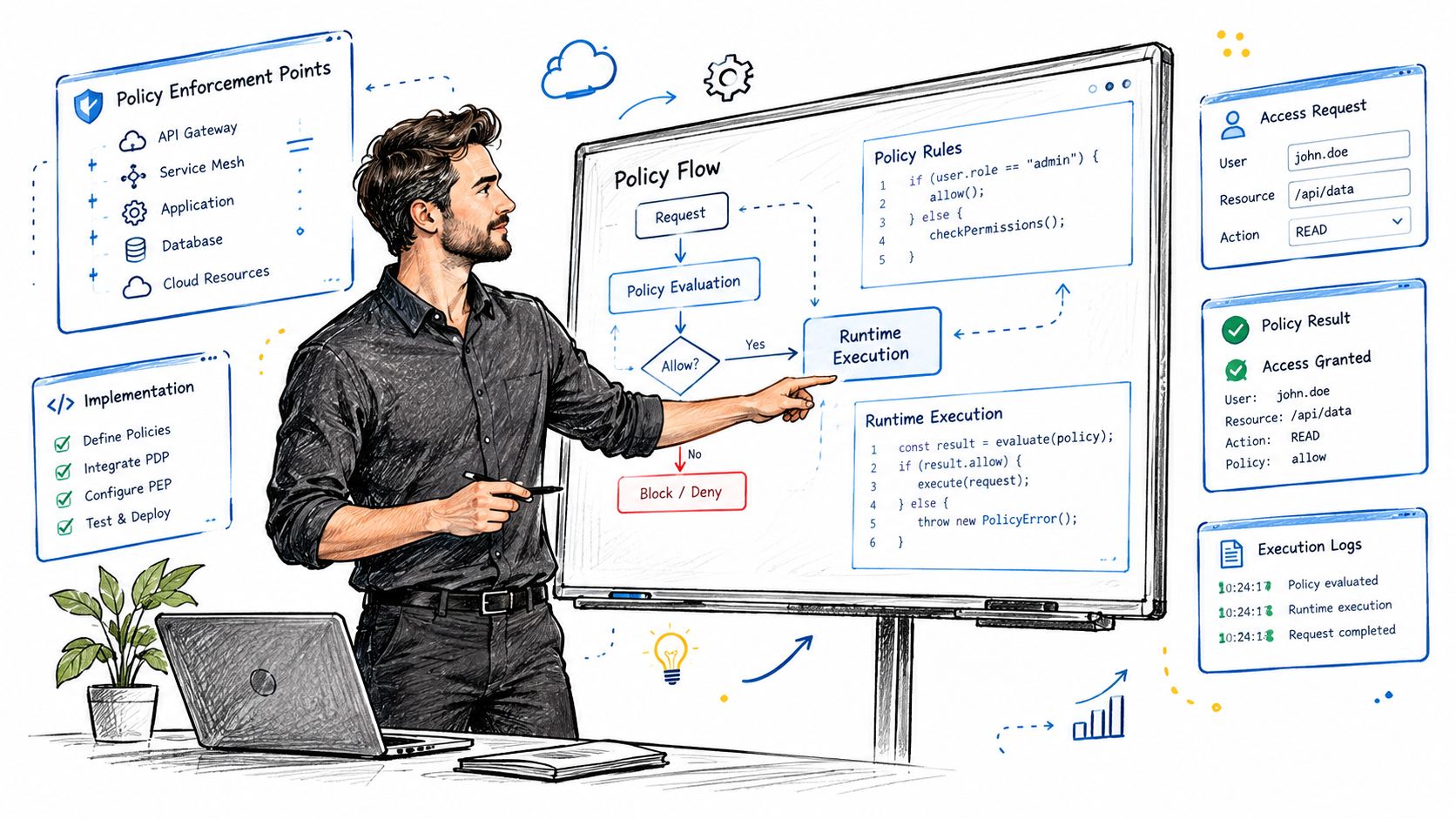
Start with the decisions your team repeats in Slack. Don't begin by trying to encode the entire employee handbook. Choose a workflow with a clear owner, recurring exceptions, and a visible cost when the process goes wrong, such as proposal approval, customer escalation, or invoice follow-up.
Start with the decision, not the prompt
In Supercenter, a team can teach an AI coworker reusable skills for how the company writes proposals, applies pricing rules, handles expenses, or maintains brand voice. The useful unit isn't a clever prompt. It's a repeatable operating instruction with clear inputs, allowed actions, escalation conditions, and expected output.
Write the rule in five parts:
- Trigger: What request or event starts the workflow?
- Required context: Which records, fields, or documents must be available?
- Allowed action: What may the coworker prepare, change, send, or delete?
- Approval boundary: Which conditions require a person to approve?
- Exception path: Who receives the issue when the normal route fails?
For example, “prepare a proposal” is too broad. A stronger rule says the coworker may retrieve the approved account data, use the current pricing guidance, draft the proposal in the company's format, and route any nonstandard term to the designated approver. It may not send the document until approval is recorded.
The AI governance platform overview is useful context for thinking about these controls as a system rather than as isolated instructions. The central design question is always the same: can the rule be applied consistently when the request arrives from a different channel or touches a different connected tool?
Test the normal path and the awkward path
A rule that works only for clean inputs isn't ready for production. Test incomplete records, conflicting ownership, missing approvals, unusual customer status, and requests from users with limited permissions. Ask someone outside the process to try the workflow, because the owner already knows the intended interpretation and may unconsciously fill in missing context.
Keep test cases concrete:
- A salesperson requests a standard proposal with complete CRM data.
- A salesperson requests a nonstandard discount without approval.
- A support lead asks for customer information they can't access.
- A finance user submits a receipt without a cost center.
- An executive asks for an action that still requires a documented approval.
The desired result isn't always “complete the task.” Sometimes it's “ask for one missing field,” “route to an owner,” or “refuse with a clear reason.” Those outcomes are part of the rule design.
Here's a practical walkthrough of the control loop in action:
<iframe width="100%" style="aspect-ratio: 16 / 9;" src="https://www.youtube.com/embed/5hK7pQsvpy0" frameborder="0" allow="autoplay; encrypted-media" allowfullscreen></iframe>Manage change like an operational system
Rules need owners and review triggers. Assign responsibility for pricing logic to revenue operations, expense logic to finance, access decisions to IT, and customer-data handling to the relevant security or privacy owner. When the underlying process changes, update the rule and test the affected workflows before relying on it again.
Permission scope matters just as much as business logic. The coworker should act on behalf of the requesting user, within that person's existing access, rather than becoming a back door to privileged data. Maintain a replayable audit trail so an operator can inspect the request, actions, approvals, overrides, and final result.
Avoid hiding exceptions in prose. If an exception is common enough to matter, give it a named path, a responsible owner, and a clear decision outcome. That makes the system easier to operate and gives employees a way forward without weakening the standard.
Building a Graduated Enforcement Strategy
A blanket block is easy to configure and difficult to live with. If every unusual request receives the same refusal, employees will move work into personal tools, private messages, or manual spreadsheets. If every request is allowed, the organization loses the benefit of having enterprise rules in the first place.
A graduated model gives operations teams more useful choices. Recent AI governance guidance on layered controls recommends moving through educate, warn, monitor, and restrict, rather than treating every violation identically. The same coverage cites an unauthorized AI usage benchmark of around 3–4% of total AI usage, with lower rates in highly regulated industries. That figure should be treated as a benchmark from the cited source, not as a universal baseline for every company.
Match the response to the risk
Use education when the employee is making a low-risk mistake and the correct behavior is easy to explain. Warn when the action may be acceptable but needs confirmation. Monitor when the workflow can proceed while the organization gathers evidence about how it is being used. Restrict when the data, destination, or action creates unacceptable exposure.
The controls can look like this:
- Educate: Explain the approved tool or process and provide the next step.
- Warn: Tell the requester what makes the action sensitive and ask for confirmation.
- Monitor: Allow the action while recording the context for review.
- Restrict: Block the action or require an authorized approval.
The model works only if the organization discovers what tools people really use. Inventory sanctioned systems, connected agents, browser tools, personal accounts, and informal workarounds. Ownership should include business operations, IT, security, and the teams doing the work, because each group sees a different part of the exposure.
Keep speed where the risk is low
Not every action deserves a human prompt. Routine internal summaries, formatting, record lookups within existing permissions, and low-risk routing can often proceed automatically. Sensitive data transfers, external commitments, financial changes, and destructive actions deserve stronger checks.
The rule should explain itself in Slack. “Blocked by policy” is a dead end. “This request includes restricted customer data and the destination isn't approved. Send it to the privacy review queue or remove those fields” gives the employee a workable path.
The AI governance policy guide can help teams frame those policies around ownership, permissions, and enforcement instead of writing another document that depends on perfect memory. The winning system isn't the most restrictive one. It's the one that distinguishes risk, preserves useful momentum, and makes the safe path easier to follow.
Supercenter provides AI coworkers that live in Slack, respond to @mentions, and execute work across 2,000+ connected business tools while applying reusable company skills and user-scoped permissions. Visit Supercenter to turn your proposal, approval, routing, or operations policies into runtime workflows with replayable audit trails.
- enterprise rules
- AI governance
- Supercenter
- workflow automation
- policy enforcement