Blogfield notes
What Is an Audit Trail and Why It Matters
At 9:14 on Tuesday morning, a manager asks an AI coworker in Slack to pull last quarter's pipeline from Salesforce, draft a recap, and post it in the team channel. The coworker runs the request, contacts a few people, attaches a chart, and moves on to the next task. By lunchtime,
At 9:14 on Tuesday morning, a manager asks an AI coworker in Slack to pull last quarter's pipeline from Salesforce, draft a recap, and post it in the team channel. The coworker runs the request, contacts a few people, attaches a chart, and moves on to the next task. By lunchtime, the thread is already buried.
Then finance asks a simple question: Who changed the forecast field, who approved the recap, and did a human review it before publication? The Slack thread offers clues, but not a reliable answer. It's incomplete, difficult to search, and easy to edit. The core question isn't whether the AI did the work. It's where the verifiable record of that work lives.
Table of Contents
- A Tuesday Morning in Slack That Changes the Question
- What an Audit Trail Actually Is
- The Anatomy of a Replayable Record
- Why AI Coworkers Break the Old Audit Trail
- Compliance Logging Versus Operational Observability
- Best Practices for an Audit Trail You Can Defend
- How Supercenter Surfaces the Trail in Practice
- From Trusting the Database to Verifying the Record
A Tuesday Morning in Slack That Changes the Question
The manager remembers asking for the pipeline report. Salesforce remembers that a forecast field changed. Slack remembers that a chart appeared in a channel. None of those records, by itself, explains the complete chain.
The request began with one person, but the action may have involved an AI coworker, a CRM connection, a spreadsheet, a charting tool, and several messages to colleagues. Perhaps the AI retried a failed Salesforce call. Perhaps it found two possible records and selected one. Perhaps a colleague approved the draft in a reply that was later edited. A basic activity feed can show fragments without showing how those fragments belong together.
That's where an audit trail earns its name. It should allow someone who wasn't present to reconstruct the business event from start to finish, including the initiating actor, the systems touched, the action taken, and the result. In regulated settings, the record also needs to remain trustworthy after the original data changes.
The practical question: If an AI coworker acts on behalf of a person, can an independent reviewer prove what happened without relying on that person's memory?
The answer matters far beyond finance. A support agent might update a customer record, an operations coworker might approve an invoice workflow, or an engineering assistant might open and close tickets across several systems. In each case, the visible conversation is only the front door. The evidence sits behind the conversation, across connected tools and delegated permissions.
A useful audit trail turns that scattered activity into a defensible sequence. It shows not just that a result appeared, but how the result came to exist. The rest of this guide explains what that record contains, why AI coworkers expose weaknesses in traditional logging, and how to make the trail reviewable rather than merely available.
What an Audit Trail Actually Is
An audit trail is a chronological, tamper-evident record of actions that lets a third party reconstruct what happened later. At minimum, it connects an actor to an action, a time, an affected object, and an outcome. A strong trail also preserves the relationship between related events, so a reviewer can follow a business process across systems.
That definition is more demanding than “the application keeps logs.” A basic activity log might record that a user signed in or that a record was updated. A defensible trail explains which record changed, what changed, who or what initiated the change, when it happened, and whether the operation succeeded. Guidance on audit trails also emphasizes controls such as append-only storage, cryptographic hashing, and WORM-style retention to make silent alteration blocked or detectable (audit-trail integrity guidance).
A log can exist and still fail
Suppose a mutable application log says, “Forecast updated.” An administrator later changes the underlying record, removes the log entry, or adjusts the displayed time. A future reviewer might still see a plausible history, but there's no reliable way to prove that the history is complete or unchanged.
A defensible trail separates the evidence from the application that produced it. It uses an append-only or otherwise protected store, limits who can read it, and preserves the sequence even if the source record is edited. The distinction is important because auditors and incident responders aren't asking only what the application currently says. They're asking what can be proven after the fact.
The four questions every event should answer
- Who or what acted? Identify the human requester, delegated AI coworker, service, or integration.
- What happened? Name the operation and the specific object it affected.
- When did it happen? Use a durable, authoritative timestamp that supports ordering.
- What was the result? Record success, failure, rejection, retry, or the resulting state.
A trail is therefore closer to a receipt with a chain of custody than to a pile of server messages. It gives reviewers evidence they can inspect, compare, and, where possible, replay.
The Anatomy of a Replayable Record
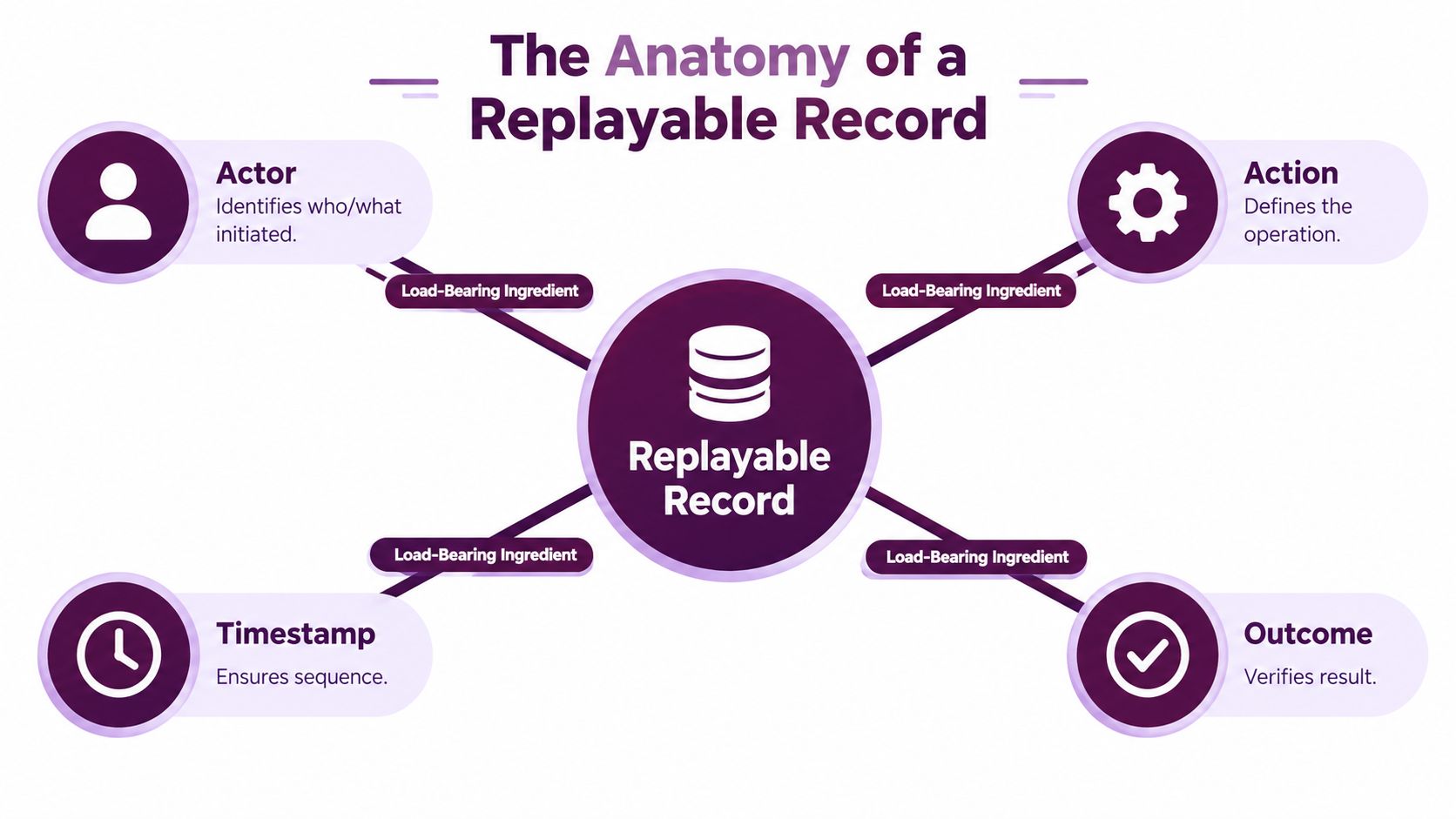
A replayable record has four load-bearing ingredients. Remove one and the event becomes harder to interpret. Remove several and the trail may show activity without proving responsibility or outcome.
Actor
The actor is not always the person whose name appears in the Slack thread. It may be an AI coworker acting under a user's delegated permission, a background workflow, or an external integration. A useful record preserves both identities: who requested or authorized the work and which agent or system performed each step.
That distinction prevents a common mistake. If every AI action is attributed only to the requesting employee, the trail hides the agent's actual behavior. If every action is attributed only to the agent, the trail loses the human context behind the delegation.
Timestamp
A timestamp establishes sequence, but only if the organization can trust its source and ordering. An event that appears after an approval may in fact have occurred before it if services use inconsistent clocks or allow users to adjust displayed times.
Auditors care about whether the timestamp can be backdated and whether related systems can be aligned. The record should make clear when the request arrived, when each tool call started, when it completed, and when a human approved or rejected the result.
Object
“Salesforce was accessed” doesn't identify the business object well enough. The record should point to the specific CRM record, file, workflow step, ticket, or message, ideally using a stable identifier that remains meaningful even when the object's title changes.
The object gives the reviewer something concrete to inspect. It also prevents unrelated actions from blending into a single vague session.
Outcome
The outcome captures what happened, not what the agent intended to do. It should distinguish a successful update from a failed attempt, a rejected approval, a retry, or an action that was deliberately skipped. For data changes, preserving the prior and resulting state makes the event easier to replay and verify.
These fields become tamper-evident when related records are chained with cryptographic hashes. Altering one event changes its hash and breaks the verification chain, making the edit visible instead of allowing it to blend into ordinary application logs. That design supports the broader principle described in guidance on defensible audit records, especially when AI configuration and cross-tool context affect the result.
An auditor doesn't need every internal implementation detail. They need to determine whether the record is complete, ordered, attributable, and resistant to silent alteration. That's the logic behind a replayable audit trail.
<iframe width="100%" style="aspect-ratio: 16 / 9;" src="https://www.youtube.com/embed/dWNkU27-GgE" frameborder="0" allow="autoplay; encrypted-media" allowfullscreen></iframe>Why AI Coworkers Break the Old Audit Trail
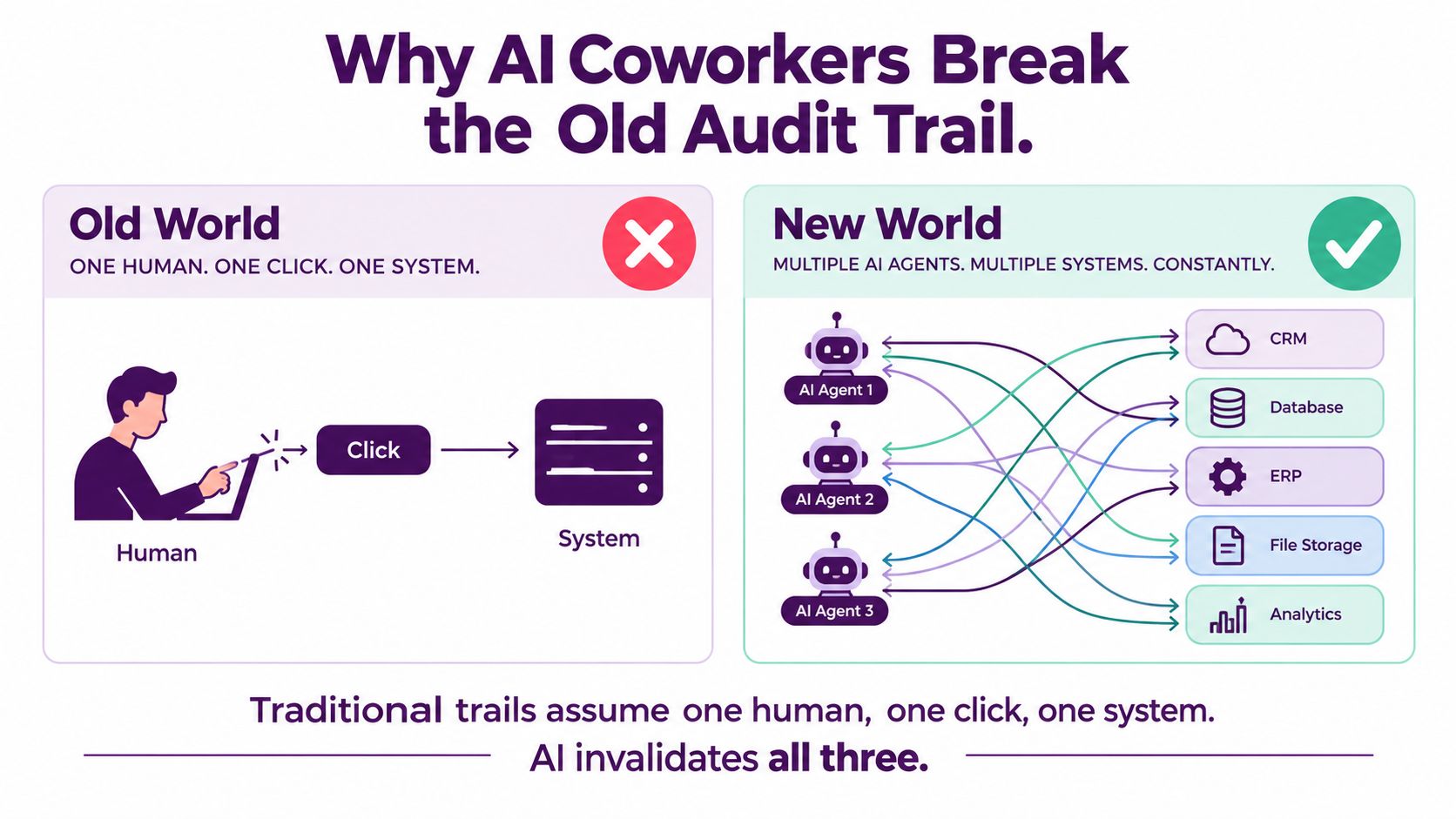
Traditional audit trails often assume a tidy transaction. One authenticated human clicks a button in one system, that system changes one object, and the log records the event. The identity is clear, the target is known, and the possible consequences are contained.
An AI coworker changes all three assumptions. One prompt can fan out into multiple tool calls, searches, retries, approvals, and external actions. The person who wrote the prompt may not be the identity that appears in Salesforce, Gmail, or a billing system. The meaningful unit of audit is no longer a single row. It's a graph of related events connected to one request.
That creates several gaps:
- Identity splits: The requester, delegated agent, connection owner, and downstream service may all be different actors.
- System boundaries multiply: Each connected tool may use a different event format, clock, identifier, and retention policy.
- Intent becomes ambiguous: A prompt can lead to actions the requester didn't explicitly list, such as looking up related records or sending a notification.
- Failure paths disappear: Retries, partial completions, rejected permissions, and skipped actions may never appear in a simple success log.
- Configuration changes matter: A different prompt, skill, permission grant, or model version can change the result even when the business request looks similar.
More events don't automatically create more accountability. Unstructured volume can bury the causal chain that a reviewer needs.
Capture the decision path, not private speculation
An AI-era trail doesn't need to expose every internal reasoning detail. It does need to preserve the operational context required to understand and reproduce the action: the triggering request, relevant configuration, delegated identity, tool calls, approvals, outputs, and failures.
The agent's omissions matter too. If it was instructed to update a customer record but refused because the requester lacked permission, that refusal is part of the story. A reviewer should be able to distinguish “the agent did nothing because the task was complete” from “the agent tried and was blocked.”
A defensible design therefore adds three elements to traditional logging:
- Delegated identity, connecting the human requester to the acting agent and connection.
- Causal links, connecting each tool call and approval to the request that produced it.
- Decision coverage, recording meaningful skips, refusals, failures, and partial outcomes.
Teams exploring the difference between raw system events and a reconstructable sequence can also review this practical overview of audit trail and logging. The key is to design for review before the organization has a tangled history to untangle.
Compliance Logging Versus Operational Observability
A compliance log and an observability system may both contain timestamps and identifiers, but they answer different questions.
Compliance logging collects evidence. It helps show who did what, when, with what authority, and with what result. The record needs appropriate retention, access controls, integrity protection, and evidence that required reviews took place.
Operational observability explains system health. Engineers use metrics, traces, and diagnostic logs to understand latency, errors, throughput, dependencies, and resource behavior. It helps them keep a workflow running, but it isn't automatically evidence that a business control operated correctly.
| Dimension | Compliance Logging | Operational Observability |
|---|---|---|
| Primary question | Who acted, what changed, and can we prove it? | Why is the system slow, failing, or behaving unexpectedly? |
| Main users | Auditors, compliance teams, security investigators, legal reviewers | Engineers, site reliability teams, support teams |
| Important records | Actor, delegated identity, object, approval, outcome, review evidence | Requests, traces, errors, latency, throughput, dependencies |
| Integrity expectation | Protected against silent alteration and deletion | Optimized for diagnosis and searchable troubleshooting |
| Retention approach | Based on policy, examination needs, and applicable obligations | Based on operational usefulness and incident investigation |
| Typical output | A defensible, reconstructable event history | A health view, trace, dashboard, or incident timeline |
A Datadog dashboard might show that an integration slowed down or returned errors. That's valuable for operations, but it doesn't by itself demonstrate that a finance approval was performed by the right person or that an AI action stayed within delegated authority. The reverse is also true. A clean audit export may prove an approval sequence, but it won't explain why the workflow took longer than expected.
The overlap can create false confidence. Teams often send compliance events into the same platform as infrastructure telemetry, then assume the shared destination solves the governance problem. It doesn't unless the compliance records have their own schema, permissions, retention policy, integrity controls, and review evidence.
For a broader explanation of why system stability involves more than uptime, see WebinOne's beyond uptime metrics article. The useful division is simple: observability keeps the service understandable, while compliance logging keeps business actions defensible.
A warning sign is a single dashboard that claims to serve auditors and engineers without separate views or controls. Auditors need proof that reviews happened and that records weren't rewritten without a trace. Engineers need flexible, high-volume diagnostics. One may feed the other, but neither replaces the other.
Best Practices for an Audit Trail You Can Defend
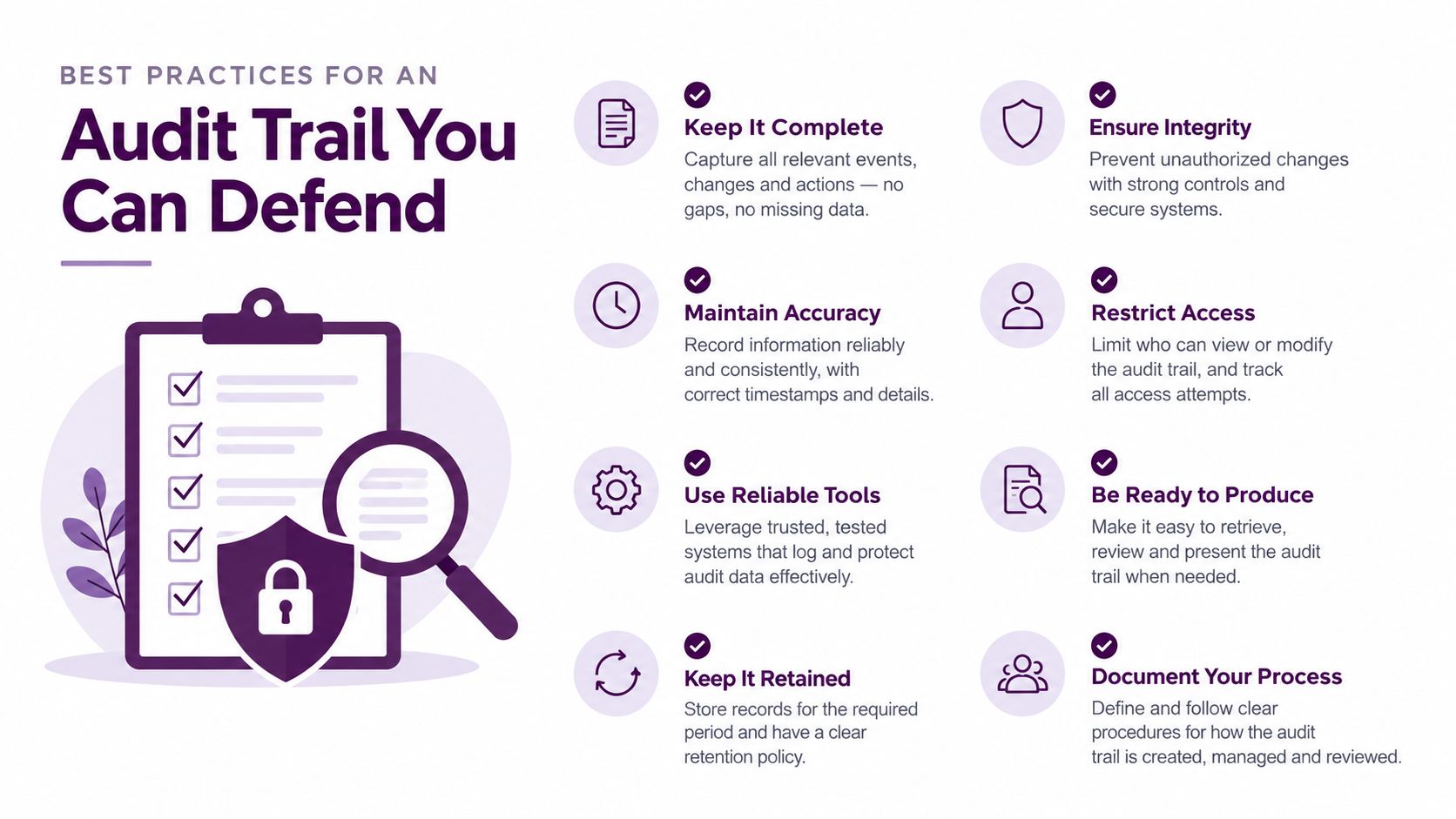
Treat the audit trail as an operating practice, not a checkbox in a product settings page. A founder doesn't need to build every component personally, but leadership should know who owns the trail, what it covers, and how the company will retrieve evidence under pressure.
Establish the record before the volume
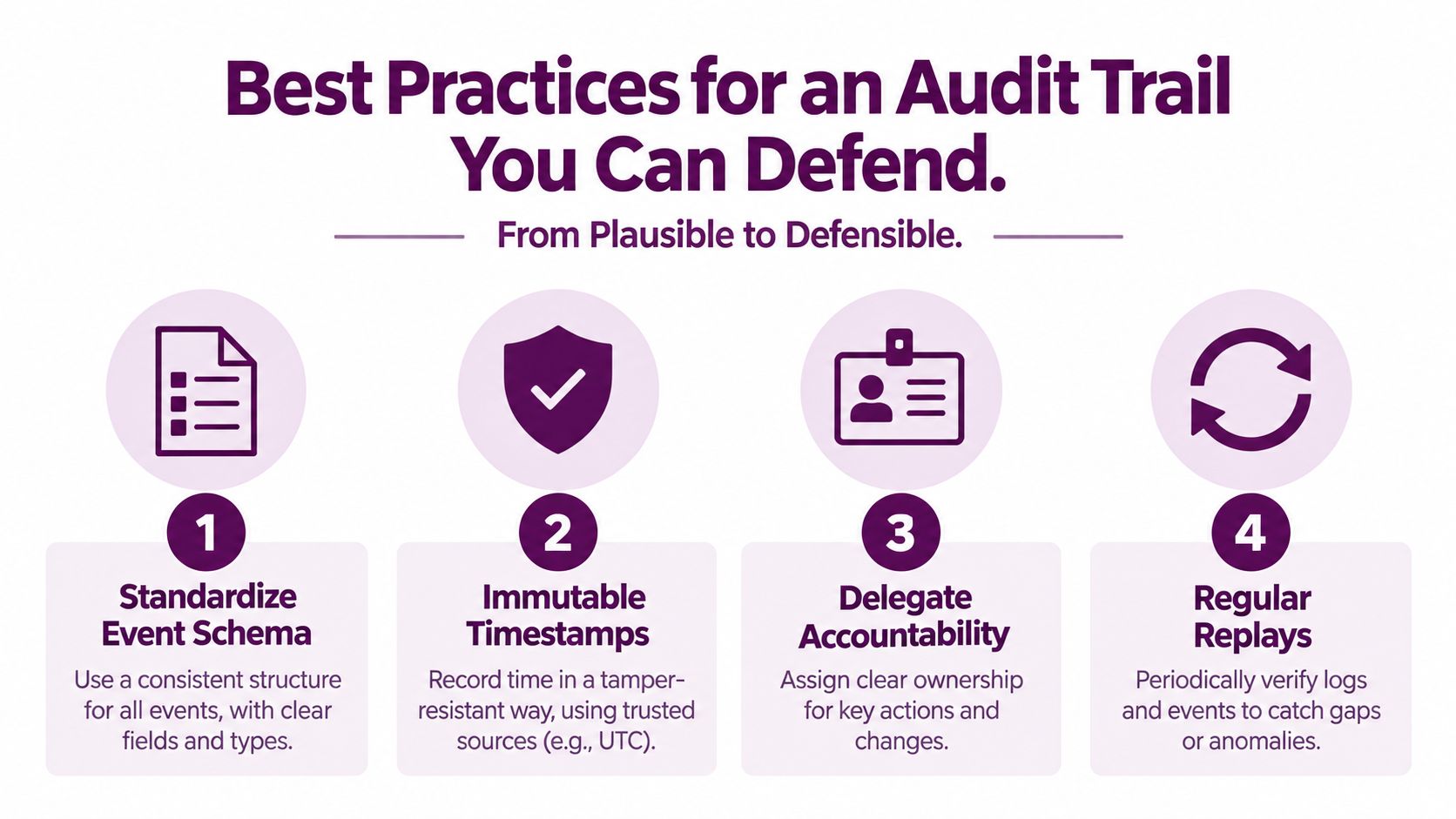
Start with a standard event schema. Define the fields that every important event must contain, including actor, delegated identity, action, object, timestamp, outcome, approval state, and relationship to the originating request.
Record failure as carefully as success. A permission denial, timeout, retry, skipped action, and partial completion can explain an incident better than the final successful update.
Preserve accountability across delegation
Don't collapse an AI coworker's activity into the name of the employee who sent the prompt. Keep the human requester, acting agent, connected account, and approval decision distinct.
That structure supports a fair review. It can show that an employee authorized a task, the agent performed a limited operation, and a separate person approved the result. It can also reveal when the agent attempted an action outside the requester's permissions.
Protect the evidence
Use append-only or write-once storage where appropriate, and separate the people who administer the logging system from those who investigate its contents. An administrator who can rewrite evidence undetected shouldn't be the only person responsible for reviewing it.
Protect access to the records as well. Audit trails can contain customer information, internal messages, and sensitive operational details. Role-based read access should be narrow enough that investigators can work without exposing the entire company history.
Test the boring parts
Time synchronization and clock-skew testing rarely attract attention until an investigation depends on event order. Verify that connected services produce timestamps that can be compared, and document how the system handles delays or missing events.
Run a retrieval drill. Select a realistic request, ask the team to produce the complete sequence, and see whether they can identify the requester, agent, tools, approvals, outcomes, and integrity evidence without relying on personal memory.
Make review visible
A policy that requires reviews but stores no proof of review creates an avoidable gap. Keep the reviewer, date, scope, findings, and follow-up decision with the evidence, then revisit the review cadence as workflows and connected tools change.
The mindset shift: An audit trail is a product with an owner, a roadmap, and a review calendar. It shouldn't be an accidental byproduct of application logging.
Teams looking for a practical checklist can use these audit trail best practices as a starting point. The exact architecture will vary, but the habits stay consistent: standardize, protect, connect, review, and test.
How Supercenter Surfaces the Trail in Practice
Consider the Tuesday scenario after a vendor record was updated overnight. The operations manager opens Slack and runs /supercenter-audit, asking what happened to the vendor record and which actions led to the change.
The thread returns a chronological view rather than a single “record updated” message. It shows the original request, the AI coworker that handled it, the connected tool it touched, the action performed, the result, and the human who approved each step. If the coworker searched for a matching vendor, retried a connection, or stopped because a permission was missing, those events remain attached to the same request.
The original prompt matters because it gives the action context. A reviewer can distinguish an authorized vendor update from an unrelated change that happened near the same time. The approval record matters because it shows whether a person reviewed the proposed action before the connected system changed.
Review without leaving the conversation
A side panel can expose the linked records behind the thread. An auditor can open the related entries, follow the hash chain, and inspect the sequence without searching separately through Slack, the CRM, and integration logs.
The workflow also keeps review actions in the evidence. A manager can approve or comment in Slack, and that decision becomes part of the trail rather than remaining as an isolated conversation fragment. A scheduled summary in a dedicated compliance channel gives the team a recurring place to review notable activity and unresolved exceptions.
This everyday surface is the important part. A technically sound backend won't help much if employees can't identify the right request or if reviewers need to reconstruct the story manually from several disconnected tools. A practical audit trail software overview can help teams compare how different products expose evidence to operators and auditors.
The same pattern can support work across CRM, finance, support, engineering, and document systems. The goal isn't to make every employee read raw events. It's to make the complete chain available when a person needs to answer a specific question.
From Trusting the Database to Verifying the Record
For years, many teams worked from a convenient assumption: if the application database contains a value, the value must reflect what happened. That assumption becomes fragile when AI coworkers can read, draft, send, approve, and modify records across connected systems without a human clicking through every screen.
Verification offers a stronger foundation. It means the organization can independently confirm the actor, request, object, sequence, authorization, and result. It can identify whether the record is complete, whether an event was altered, and whether the final state matches the action that produced it.
That doesn't mean every workflow needs an enormous archive of every possible signal. More data can create more noise, privacy exposure, and review difficulty. The useful trail is selective and structured. It captures the events needed to understand the business action, the configuration that could affect the result, and the evidence that a human or policy approved the right step.
This week, choose one AI-assisted workflow and run a simple tabletop exercise. Ask your team to produce the answer to who acted, what changed, when it happened, why it was authorized, and what happened when the action failed. If the answer requires searching personal inboxes or asking the original requester to remember the sequence, your current logging system is not yet a defensible audit trail.
A replayable record turns governance from trust in a database into verification of an event. That shift becomes essential as AI coworkers take on more work across more tools.
Supercenter provides AI coworkers inside Slack and Microsoft Teams that can carry out tasks across connected business tools while preserving a full, replayable record of actions taken on a user's behalf. Visit Supercenter to see how your team can make delegated AI work easier to review, approve, and defend.
- audit trail
- compliance
- AI coworkers
- security
- log management